


Page 120 - Template Tesis UTM v2.0
P. 120
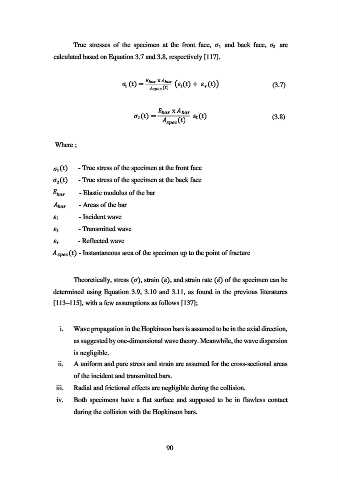
True  stresses  of  the  specimen  at  the  front  face,       and  back  face,       are
                                                                                                 2
                                                                             1
                   calculated based on Equation 3.7 and 3.8, respectively [117].


                                              (  ) =             x            (   (  ) +    (  ))   (3.7)

                                             1

                                                                 (  )

                                                                   x
                                                   (  ) =               (  )                    (3.8)
                                                 2

                                                                      (  )

                    Where ;


                      (  )      - True stress of the specimen at the front face
                     1
                      (  )      - True stress of the specimen at the back face
                     2
                                  - Elastic modulus of the bar
                                  - Areas of the bar

                              - Incident wave

                               - Transmitted wave

                              - Reflected wave

                               (  ) - Instantaneous area of the specimen up to the point of fracture


                           Theoretically, stress (  ), strain (  ), and strain rate (  ̇) of the specimen can be

                   determined using Equation 3.9, 3.10 and 3.11, as found in the previous literatures

                   [113–115], with a few assumptions as follows [137];


                      i.   Wave propagation in the Hopkinson bars is assumed to be in the axial direction,

                           as suggested by one-dimensional wave theory. Meanwhile, the wave dispersion
                           is negligible.

                     ii.   A uniform and pure stress and strain are assumed for the cross-sectional areas

                           of the incident and transmitted bars.
                    iii.   Radial and frictional effects are negligible during the collision.

                     iv.   Both  specimens  have  a  flat  surface and supposed to  be in  flawless  contact
                           during the collision with the Hopkinson bars.


                                                           90

