


Page 115 - Template Tesis UTM v2.0
P. 115
Low-velocity impact test was carried out according to ASTM D7136-12 [133],

                   by using the instrumented drop weight impact test, Instron-Ceast 9350 as shown in
                   Figure 3.9.  The specimens  were cut  with  a dimension of 100 mm x 100 mm  and

                   clamped circumferentially along a diameter of 75 mm. Prior to the test, specimens
                   were automatically clamped, then impacted with an indentor identical to the one used

                   in  the quasi-static  indentation  test. To prevent  the specimen from having  multiple
                   impacts, the tup was caught on the rebound by a brake in the test apparatus. Damage

                   was imparted through out-of-plane, concentrated impact (perpendicular to the plane of

                   the laminated plate) and the damage resistance was calculated in terms of size and type
                   of  failure  mode  exhibited  in  the  specimens.  In  general,  the  damage  resistance

                   properties  generated  are  highly  dependent  on  several  factors,  including  specimen
                   geometry, lay-up, impactor geometry, impactor mass, impact force, impact energy,

                   and  boundary  conditions  [133].  The  contact  force  history  of  the  specimens  was
                   obtained from the instrumented tup and the data was measured by a high-speed data

                   acquisition device (DAS 64K) with a sampling rate of 100 kHz. At least three impact

                   tests were performed for each sample to obtain the average data. The impact energy is
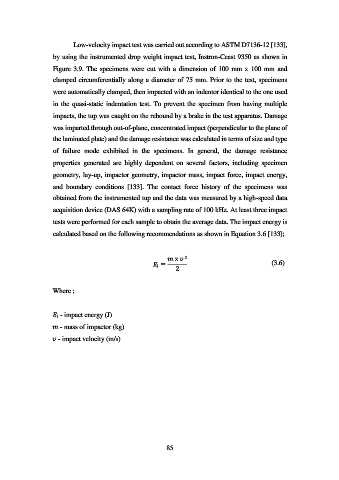
                   calculated based on the following recommendations as shown in Equation 3.6 [133];


                                                               x    2
                                                          =                                     (3.6)

                                                              2


                   Where ;


                       - impact energy (J)

                      - mass of impactor (kg)

                      - impact velocity (m/s)


                                                           85

