


Page 10 - Spotlight A+ Form 4 & 5 Chemistry KSSM
P. 10
Form
           4
                      Chemistry   Chapter 5 Chemical Bond
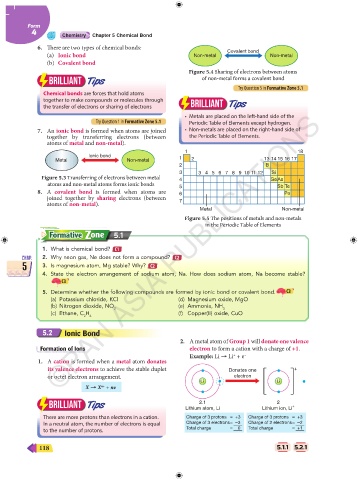
              6.  There are two types of chemical bonds:
                (a)  Ionic bond                                  Non-metal  Covalent bond  Non-metal
                (b)  Covalent bond
                                                               Figure 5.4 Sharing of electrons between atoms
                                                                   of non-metal forms a covalent bond
                                                                               Try Question 5 in Formative Zone 5.1
               Chemical bonds are forces that hold atoms
               together to make compounds or molecules through
               the transfer of electrons or sharing of electrons
                                                              •  Metals are placed on the left-hand side of the
                    ©PAN ASIA PUBLICATIONS
                                Try Question 1 in Formative Zone 5.1  Periodic Table of Elements except hydrogen.
               7.  An ionic bond is formed when atoms are joined   •  Non-metals are placed on the right-hand side of
                together by transferring electrons (between    the Periodic Table of Elements.
                atoms of metal and non-metal).
                                                              1                                    18
                              Ionic bond                    1
                   Metal                   Non-metal            2                       13 14 15 16 17
                                                            2                           B
                                                            3     3 4 5 6 7 8 9 10 11 12  Si
               Figure 5.3 Transferring of electrons between metal   4                     GeAs
                 atoms and non-metal atoms forms ionic bonds  5                             Sb Te
               8.  A  covalent bond  is  formed  when  atoms  are   6                         Po
                joined together by  sharing electrons (between
                atoms of non-metal).                        7
                                                                   Metal                     Non-metal
                                                              Figure 5.5 The positions of metals and non-metals
                                                                    in the Periodic Table of Elements
                                      5.1

               1.  What is chemical bond?  C1
        CHAP.    2.  Why neon gas, Ne does not form a compound?  C2                                                                                                                                                      CHAP.
        5      3.  Is magnesium atom, Mg stable? Why?  C2                                                                                                                                                                 5

               4.  State the electron arrangement of sodium atom, Na. How does sodium atom, Na become stable?
                     C3
               5.  Determine whether the following compounds are formed by ionic bond or covalent bond.  C3
                  (a)  Potassium chloride, KCl              (d)  Magnesium oxide, MgO
                  (b) Nitrogen dioxide, NO                  (e)  Ammonia, NH
                                      2                                   3
                  (c)  Ethane, C H                          (f)  Copper(II) oxide, CuO
                             2  6
               5.2    Ionic Bond
                                                              2.  A metal atom of Group 1 will donate one valence
              Formation of Ions                                electron to form a cation with a charge of +1.
                                                               Example: Li → Li  + e –
                                                                              +
              1.  A cation is formed when a metal atom donates
                 its valence electrons to achieve the stable duplet         Donates one           +
                 or octet electron arrangement.                               electron
                                                                   Li                       Li
                             X → X  + ne –
                                  n+
                                                                  2.1                       2
                                                                                                 +
                                                              Lithium atom, Li         Lithium ion, Li
               There are more protons than electrons in a cation.   Charge of 3 protons  =  +3  Charge of 3 protons  =  +3
               In a neutral atom, the number of electrons is equal   Charge of 3 electrons =  –3  Charge of 2 electrons =  –2
               to the number of protons.                      Total charge   =    0  Total charge   =  +1


              118                                                                           5.1.1  5.2.1

