


Page 12 - Spotlight A+ Form 4 & 5 Chemistry KSSM
P. 12
Form
           4
                      Chemistry   Chapter 5 Chemical Bond
              Effect of Hydrogen Bond on the Physical
              Properties of Substances

               1.  Hydrogen bonds will affect the solubility and   The oxygen atom is partially negatively charged,
                 boiling point of a covalent compound.       and the hydrogen atom is partially positively
               2.  Boiling point:                            charged.
                (a)  The boiling point of ethane, C H  is
                                                  2
                                                    6
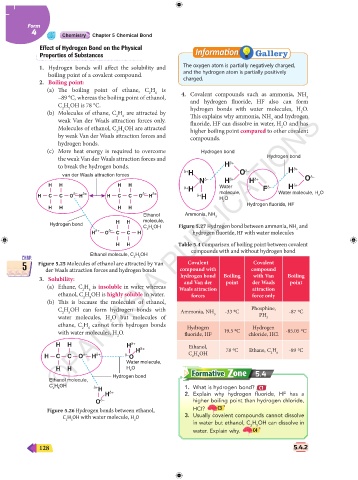
                    –89 °C, whereas the boiling point of ethanol,     4.  Covalent compounds such as ammonia, NH
                                                                                                      3
                                                               and  hydrogen  fluoride,  HF  also  can  form
                    C H OH is 78 °C.                           hydrogen bonds with water molecules, H O.
                     2
                       5
                (b)  Molecules of ethane, C H  are attracted by   This explains why ammonia, NH  and hydrogen
                                                                                                    2
                    5©PAN ASIA PUBLICATIONS
                                       2
                                         6
                    weak Van der Waals attraction forces only.   fluoride, HF can dissolve in water, H O and has
                                                                                          3
                                                                                             2
                    Molecules of ethanol, C H OH are attracted   higher boiling point compared to other covalent
                                       2
                                         5
                    by weak Van der Waals attraction forces and   compounds.
                    hydrogen bonds.
                (c)  More heat energy is required to overcome      Hydrogen bond
                    the weak Van der Waals attraction forces and                         Hydrogen bond
                    to break the hydrogen bonds.                           H δ+                  δ+
                                                             δ+ H               O δ–            H
                     van der Waals attraction forces                                                   δ–
                                                                  N δ–     H δ+    H δ+              O
                 H  H                   H  H                                                     δ+
                                                             δ+ H        Water         F δ–     H
                         δ–  δ+                 δ–  δ+                   molecule,          Water molecule, H O
             H   C  C   O  H        H   C  C   O  H               δ+ H   H O                             2
                                                                          2
                                                                                  Hydrogen fluoride, HF
                 H  H                   H  H
                                                Ethanol       Ammonia, NH 3
                                       H   H    molecule,
                 Hydrogen bond                              Figure 5.27 Hydrogen bond between ammonia, NH  and
                                                C H OH
                                δ+   δ–          2  5                                             3
                               H   O   C   C  H                 hydrogen fluoride, HF with water molecules
                                       H   H                Table 5.4 Comparison of boiling point between covalent
                                                                compounds with and without hydrogen bond
                               Ethanol molecule, C H OH
        CHAP.                                2  5              Covalent             Covalent                                                                                                                             CHAP.
        5     Figure 5.25 Molecules of ethanol are attracted by Van   compound with   compound                                                                                                                            5
                der Waals attraction forces and hydrogen bonds
                                                                                    with Van
               3.  Solubility:                              hydrogen bond   Boiling   der Waals   Boiling
                                                             and Van der
                                                                                                point
                                                                           point
                (a)  Ethane, C H  is insoluble in water whereas   Waals attraction   attraction
                              6
                            2
                    ethanol, C H OH is highly soluble in water.  forces             force only
                            2
                              5
                (b)  This is because the molecules of ethanol,
                    C H OH  can  form  hydrogen  bonds  with   Ammonia, NH  -33 0C  Phosphine,   -87 0C
                     2
                       5
                    water molecules, H O but molecules of              3              PH 3
                                     2
                    ethane, C H  cannot form hydrogen bonds   Hydrogen              Hydrogen
                            2
                              6
                    with water molecules, H O.                fluoride, HF  19.5 0C  chloride, HCl  -85.05 0C
                                       2
                   H   H                   H δ+                Ethanol,
                                              H δ+                         78 0C   Ethane, C H 6  -89 0C
                                                                                          2
                            δ–   δ+       δ–                   C H OH
                H  C   C   O   H           O                    2  5
                                          Water molecule,
                   H   H                  H O
                                            2
                                      Hydrogen bond                                  5.4
                 Ethanol molecule,
                 C H OH                                       1.  What is hydrogen bond?  C1
                                 H   δ+
                  2             δ+
                                   H                          2.  Explain  why  hydrogen  fluoride,  HF  has  a
                                O δ–                              higher boiling point than hydrogen chloride,
                 Figure 5.26 Hydrogen bonds between ethanol,    HCI?    C3
                      C H OH with water molecule, H O         3.  Usually covalent compounds cannot dissolve
                                             2
                        5
                       2
                                                                in water but ethanol, C H OH can dissolve in
                                                                                   2  5
                                                                water. Explain why.   C4
              128                                                                                5.4.2

