


Page 11 - Spotlight A+ Form 4 & 5 Chemistry KSSM
P. 11
Form
                                                                                                           4
                                                                    Chapter 5 Chemical Bond   Chemistry
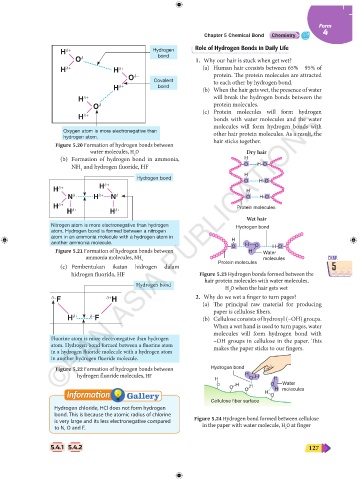
                                                                 Role of Hydrogen Bonds in Daily Life
                     H δ+                          Hydrogen
                          O δ–                       bond         1.  Why our hair is stuck when get wet?
                     H δ+             H δ+                         (a)  Human hair consists between 65% – 95% of
                                           O δ–                        protein. The protein molecules are attracted
                                                   Covalent            to each other by hydrogen bond.
                                      H δ+           bond          (b)  When the hair gets wet, the presence of water

                           H δ+                                        will break the hydrogen bonds between the
                                                                       protein molecules.
                                O δ–                               (c)  Protein molecules will form hydrogen
                    ©PAN ASIA PUBLICATIONS
                           H δ+                                        bonds with water molecules and the water
                                                                       molecules will form hydrogen bonds with
                      Oxygen atom is more electronegative than         other hair protein molecules. As a result, the
                      hydrogen atom.
                   Figure 5.20 Formation of hydrogen bonds between     hair sticks together.
                               water molecules, H O                               Dry hair
                                             2
                     (b)  Formation of hydrogen bond in ammonia,                 H
                        NH  and hydrogen fluoride, HF                            O   H O
                           3
                                                                                 H
                                              Hydrogen bond
                                                                                 O    H O
                   H δ+           H δ+                                            H
                       N δ–     H δ+  N δ–                                        O   H O
                   H δ+                                                        Protein molecules
                       H δ+          H δ+
                                                                                  Wet hair
                  Nitrogen atom is more electronegative than hydrogen         Hydrogen bond
                  atom. Hydrogen bond is formed between a nitrogen
                  atom in an ammonia molecule with a hydrogen atom in        H
                  another ammonia molecule.                                      H   O
                                                                                          H O
                   Figure 5.21 Formation of hydrogen bonds between           O     H   Water
 CHAP.                       ammonia molecules, NH 3                                   molecules             CHAP.
 5                   (c)  Pembentukan ikatan hidrogen dalam              Protein molecules                    5
                        hidrogen fluorida, HF                     Figure 5.23 Hydrogen bonds formed between the
                                                                    hair protein molecules with water molecules,
                                              Hydrogen bond                H O when the hair gets wet
                                                                            2
                  δ– F              δ+ H                          2.  Why do we wet a finger to turn pages?
                                                                   (a)  The principal raw material for producing
                                                                       paper is cellulose fibers.
                       H δ+   δ– F                                 (b)  Cellulose consists of hydroxyl (–OH) groups.
                                                                       When a wet hand is used to turn pages, water
                                                                       molecules will form hydrogen bond with
                  Fluorine atom is more electronegative than hydrogen   –OH groups in cellulose in the paper. This
                  atom. Hydrogen bond formed between a fluorine atom
                  in a hydrogen fluoride molecule with a hydrogen atom   makes the paper sticks to our fingers.
                  in another hydrogen fluoride molecule.

                   Figure 5.22 Formation of hydrogen bonds between    Hydrogen bond
                          hydrogen fluoride molecules, HF                        H   H
                                                                        H          O       H
                                                                        O     H    H      O   Water
                                                                            O
                                                                                 O         H  molecules
                                                                                        H
                                                                                          O
                                                                      Cellulose fiber surface
                   Hydrogen chloride, HCl does not form hydrogen
                   bond. This is because the atomic radius of chlorine
                   is very large and its less electronegative compared   Figure 5.24 Hydrogen bond formed between cellulose
                   to N, O and F.                                  in the paper with water molecule, H O at finger
                                                                                              2

                  5.4.1 5.4.2                                                                         127

