


Page 9 - Spotlight A+ Form 4 & 5 Chemistry KSSM
P. 9
Form
                                                                                                           4
                                                                    Chapter 5 Chemical Bond   Chemistry
                   5.1    Basics of Compound Formation

                  1.  Different elements that are  chemically bonded   Types of Chemical Bonds
                     together but not mixed together are called   http://bit.ly/2OeUnAH
                     compounds.
                     Example:
                    •  Water is a compound of hydrogen and oxygen      5.  Chemical bonds are formed through the transfer
                    •  Carbon dioxide is a compound of carbon and   of electrons or share of electrons.
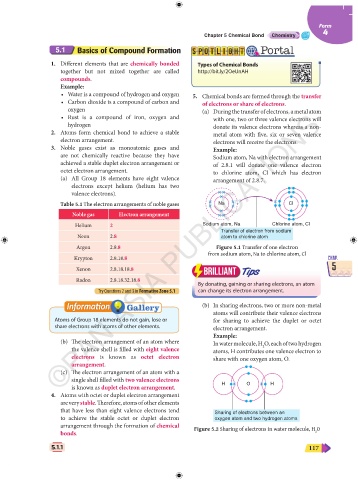
                       oxygen                                      (a)  During the transfer of electrons, a metal atom
                    ©PAN ASIA PUBLICATIONS
                    •  Rust is a compound of iron, oxygen and          with one, two or three valence electrons will
                       hydrogen                                        donate its valence electrons whereas a non-
                  2.  Atoms form chemical bond to achieve a stable     metal  atom  with  five,  six  or  seven  valence
                     electron arrangement.                             electrons will receive the electrons.
                  3.   Noble gases exist as monoatomic gases and       Example:
                     are not chemically reactive because they have      Sodium atom, Na with electron arrangement
                     achieved a stable duplet electron arrangement or   of 2.8.1 will donate one valence electron
                     octet electron arrangement.                       to chlorine atom, Cl which has electron
                     (a)  All Group 18 elements have eight valence     arrangement of 2.8.7.
                        electrons except helium (helium has two
                        valence electrons).
                     Table 5.1 The electron arrangements of noble gases  Na                     Cl
                         Noble gas      Electron arrangement
                          Helium     2                             Sodium atom, Na        Chlorine atom, Cl
                                                                          Transfer of electron from sodium
                          Neon       2.8                                  atom to chlorine atom
                          Argon      2.8.8                              Figure 5.1 Transfer of one electron
                                                                     from sodium atom, Na to chlorine atom, Cl
 CHAP.                   Krypton     2.8.18.8                                                                CHAP.
 5                        Xenon      2.8.18.18.8                                                              5

                          Radon      2.8.18.32.18.8
                                                                  By donating, gaining or sharing electrons, an atom
                                 Try Questions 2 and 3 in Formative Zone 5.1  can change its electron arrangement.

                                                                   (b)  In sharing electrons, two or more non-metal
                                                                       atoms will contribute their valence electrons
                   Atoms of Group 18 elements do not gain, lose or     for sharing  to achieve  the duplet or octet
                   share electrons with atoms of other elements.       electron arrangement.
                                                                       Example:
                     (b)  The electron arrangement of an atom where      In water molecule, H O, each of two hydrogen
                                                                                       2
                        the valence shell is filled with eight valence   atoms, H contributes one valence electron to
                        electrons  is  known  as  octet electron       share with one oxygen atom, O.
                        arrangement.
                     (c)  The electron arrangement of an atom with a
                        single shell filled with two valence electrons
                        is known as duplet electron arrangement.          H       O       H
                  4.  Atoms with octet or duplet electron arrangement
                     are very stable. Therefore, atoms of other elements
                     that have less than eight valence electrons tend   Sharing of electrons between an
                     to achieve the stable octet or duplet electron    oxygen atom and two hydrogen atoms
                     arrangement through the formation of chemical   Figure 5.2 Sharing of electrons in water molecule, H O
                     bonds.                                                                             2

                  5.1.1                                                                               117

