


Page 14 - Spotlight A+ Form 4 & 5 Chemistry KSSM
P. 14
Form
           4
                      Chemistry   Chapter 5 Chemical Bond
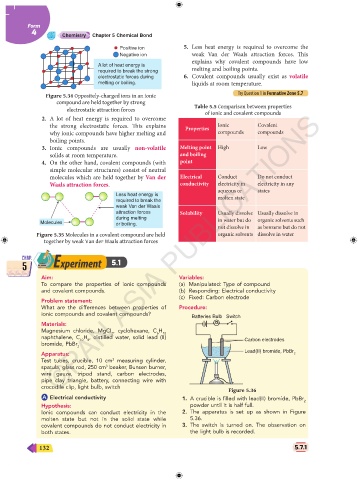
                                        Positive ion         5.  Less heat energy is required to overcome the
                                        Negative ion            weak Van  der Waals attraction  forces. This
                                                                explains why covalent compounds have low
                                 A lot of heat energy is        melting and boiling points.
                                 required to break the strong
                                 electrostatic forces during     6.  Covalent compounds usually exist as  volatile
                                 melting or boiling.            liquids at room temperature.

                Figure 5.34 Oppositely-charged ions in an ionic                Try Question 1 in Formative Zone 5.7
                    compound are held together by strong
                       electrostatic attraction forces           Table 5.5 Comparison between properties
                                                                    of ionic and covalent compounds
               2.  A lot of heat energy is required to overcome
                 the strong electrostatic forces. This explains   Properties  Ionic    Covalent
                 why ionic compounds have higher melting and            compounds    compounds
                 boiling points.
               3.  Ionic compounds are usually  non-volatile   Melting point  High   Low
                 solids at room temperature.                and boiling
               4.  On the other hand, covalent compounds (with   point
                 simple molecular structures) consist of neutral
                 molecules which are held together by Van der   Electrical    Conduct   Do not conduct
                 Waals attraction forces.                   conductivity  electricity in   electricity in any
                                                                        aqueous or   states
                                       Less heat energy is              molten state
                                       required to break the
                                       weak Van der Waals
                                       attraction forces    Solubility    Usually dissolve  Usually dissolve in
                                       during melting                   in water but do  organic solvents such
              Molecules                or boiling.
                                                                        not dissolve in   as benzene but do not
             Figure 5.35 Molecules in a covalent compound are held      organic solvents dissolve in water
               together by weak Van der Waals attraction forces


        CHAP.       ©PAN ASIA PUBLICATIONS                                                                                                                                                                               CHAP.
        5                             5.1                                                                                                                                                                                 5

               Aim:                                         Variables:
               To compare the properties of ionic compounds   (a)  Manipulated: Type of compound
               and covalent compounds.                      (b)  Responding: Electrical conductivity
                                                            (c)  Fixed: Carbon electrode
               Problem statement:
               What are the differences between properties of   Procedure:
               ionic compounds and covalent compounds?
                                                                Batteries Bulb Switch
               Materials:
               Magnesium chloride, MgCI , cyclohexane, C H
                                      2             6  12
               naphthalene, C H , distilled water, solid lead (II)
                           10  8                                                 Carbon electrodes
               bromide, PbBr
                          2
                                                                                 Lead(II) bromide, PbBr
               Apparatus:                                                                        2
               Test tubes, crucible, 10 cm  measuring cylinder,
                                      3
                                    3
               spatula, glass rod, 250 cm  beaker, Bunsen burner,
               wire gauze, tripod stand, carbon electrodes,
               pipe clay triangle, battery, connecting wire with
               crocodile clip, light bulb, switch                           Figure 5.36
               A  Electrical conductivity                     1.  A crucible is filled with lead(II) bromide, PbBr
                                                                                                     2
               Hypothesis:                                     powder until it is half full.
               Ionic compounds can conduct electricity in the     2.  The  apparatus  is  set  up  as  shown  in  Figure
               molten  state  but  not in  the  solid  state  while   5.36.
               covalent compounds do not conduct electricity in     3.  The switch is turned on. The observation on
               both states.                                    the light bulb is recorded.

              132                                                                                 5.7.1

