


Page 254 - Towards_a_New_Malaysia_The_2018_Election_and_Its_6146371_(z-lib.org)
P. 254
Malaysia’s First-Past-the-Post Electoral System              239

                  British Labour Party has voluntarily adopted ‘all-women shortlists’ to reserve
                  a portion of winnable constituencies for female candidates (Kelly and White
                  2016). Replicating the Indian and British measures might be more di cult
                  than moving away from FPTP in Malaysia, where the calls for a 30 per cent
                  candidacy quota have fallen on deaf ears since 1999.  e single-member nature
                  of FPTP makes enforcement of gender quotas personal to male incumbents
                  and aspirants; parties have little incentive to enforce quotas, which also risk
                  voters’ backlash.


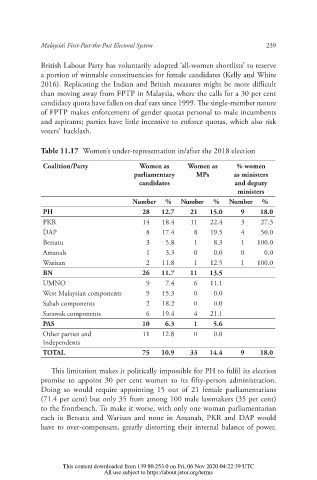
                  Table 11.17  Women’s under-representation in/after the 2018 election
                   Coalition/Party           Women as     Women as     % women
                                           parliamentary    MPs       as ministers
                                             candidates                and deputy
                                                                       ministers
                                           Number   %   Number   %   Number   %
                   PH                         28   12.7    21   15.0    9    18.0
                   PKR                        14   18.4    11   22.4    3     27.3
                   DAP                         8   17.4     8   19.5    4     50.0
                   Bersatu                     3    5.8     1    8.3    1    100.0
                   Amanah                      1    3.3     0    0.0    0      0.0
                   Warisan                     2   11.8     1   12.5    1    100.0
                   BN                         26   11.7    11   13.5
                   UMNO                        9    7.4     6   11.1
                   West Malaysian components   9   15.3     0    0.0
                   Sabah components            2   18.2     0    0.0
                   Sarawak components          6   19.4     4   21.1
                   PAS                        10    6.3     1    5.6
                   Other parties and          11   12.8     0    0.0
                   Independents
                   TOTAL                      75   10.9    33   14.4    9    18.0
                      is limitation makes it politically impossible for PH to ful l its election
                  promise to appoint 30  per  cent women to its   fty-person administration.
                  Doing so would require appointing 15 out of 21 female parliamentarians
                  (71.4 per cent) but only 35 from among 100 male lawmakers (35 per cent)
                  to the frontbench. To make it worse, with only one woman parliamentarian
                  each in Bersatu and Warisan and none in Amanah, PKR and DAP would
                  have to over-compensate, greatly distorting their internal balance of power.


                        This content downloaded from 139.80.253.0 on Fri, 06 Nov 2020 04:22:39 UTC
                                   All use subject to https://about.jstor.org/terms

