


Page 250 - Towards_a_New_Malaysia_The_2018_Election_and_Its_6146371_(z-lib.org)
P. 250
Malaysia’s First-Past-the-Post Electoral System              235

                  to hold on to its home turf in the Malay heartland, not to win power from the
                  middle ground. British political scientist David Robertson (1976: 42) o ers a
                  powerful insight into centripetal competition: when competition is idle, the
                  party may choose to please the median party member rather than the median
                  voter because ‘vote maximisation, over and above what is necessary to win,
                  will not take place’. Precisely because UMNO and its allies have already lost
                  the Chinese, Indian, and Borneo votes, a middle-ground positioning will not
                  help in winning back mixed constituencies but will instead reduce its appeal
                  vis-à-vis  PH in the Malay  heartland. In this sense, the exodus  of  UMNO
                  parliamentarians to Bersatu only makes UMNO more short-term-minded and
                  dependent on PAS for its survival.
                     FPTP encourages unity by punishing losers but it has no normative preference
                  between inter-communal inclusion or exclusion. In 2018, Prime Minister
                  Najib Razak hoped to use PAS as spoiler to divide the opposition’s Malay votes
                  and enable BN’s victory as plurality winner in marginal constituencies.  is
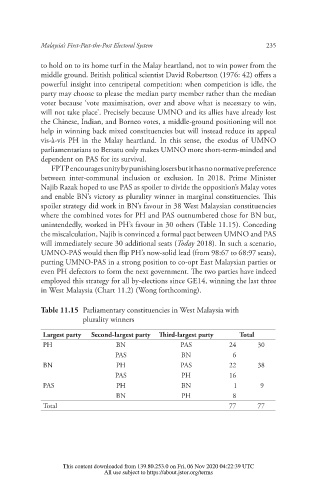
                  spoiler strategy did work in BN’s favour in 38 West Malaysian constituencies
                  where the combined votes for PH and PAS outnumbered those for BN but,
                  unintendedly, worked in PH’s favour in 30 others (Table 11.15). Conceding
                  the miscalculation, Najib is convinced a formal pact between UMNO and PAS
                  will immediately secure 30 additional seats (Today 2018). In such a scenario,
                  UMNO-PAS would then  ip PH’s now-solid lead (from 98:67 to 68:97 seats),
                  putting UMNO-PAS in a strong position to co-opt East Malaysian parties or
                  even PH defectors to form the next government.  e two parties have indeed
                  employed this strategy for all by-elections since GE14, winning the last three
                  in West Malaysia (Chart 11.2) (Wong forthcoming).

                  Table 11.15  Parliamentary constituencies in West Malaysia with
                              plurality winners
                   Largest party  Second-largest party   ird-largest party  Total
                   PH                  BN               PAS          24      30
                                      PAS               BN             6
                   BN                  PH               PAS          22      38
                                      PAS               PH           16
                   PAS                 PH               BN              1     9
                                       BN               PH             8
                   Total                                             77      77


                        This content downloaded from 139.80.253.0 on Fri, 06 Nov 2020 04:22:39 UTC
                                   All use subject to https://about.jstor.org/terms

