


Page 252 - Towards_a_New_Malaysia_The_2018_Election_and_Its_6146371_(z-lib.org)
P. 252
Malaysia’s First-Past-the-Post Electoral System              237

                  a community feeling embattled, the obvious solution is then to trade political
                  pluralism for communal strength, and competition for representation.

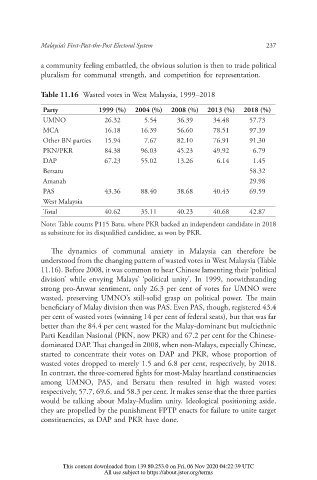
                  Table 11.16  Wasted votes in West Malaysia, 1999–2018

                   Party          1999 (%)  2004 (%)  2008 (%)  2013 (%)  2018 (%)
                   UMNO            26.32       5.54    36.39     34.48    57.73
                   MCA             16.18     16.39     56.60     78.51     97.39
                   Other BN parties  15.94     7.67    82.10     76.91     91.30
                   PKN/PKR         84.38     96.03     45.23     49.92      6.79
                   DAP             67.23     55.02     13.26       6.14     1.45
                   Bersatu                                                 58.32
                   Amanah                                                  29.98
                   PAS             43.36     88.40     38.68     40.43     69.59
                   West Malaysia
                   Total           40.62     35.11     40.23     40.68     42.87
                  Note: Table counts P115 Batu, where PKR backed an independent candidate in 2018
                  as substitute for its disquali ed candidate, as won by PKR.

                      e dynamics of communal anxiety in Malaysia can therefore be
                  understood from the changing pattern of wasted votes in West Malaysia (Table
                  11.16). Before 2008, it was common to hear Chinese lamenting their ‘political
                  division’ while envying Malays’ ‘political unity’. In 1999, notwithstanding
                  strong pro-Anwar sentiment, only 26.3 per cent of votes for UMNO were
                  wasted, preserving UMNO’s still-solid grasp on political power.  e main
                  bene ciary of Malay division then was PAS. Even PAS, though, registered 43.4
                  per cent of wasted votes (winning 14 per cent of federal seats), but that was far
                  better than the 84.4 per cent wasted for the Malay-dominant but multiethnic
                  Parti Keadilan Nasional (PKN, now PKR) and 67.2 per cent for the Chinese-
                  dominated DAP.  at changed in 2008, when non-Malays, especially Chinese,
                  started to concentrate their votes on DAP and PKR, whose proportion of
                  wasted votes dropped to merely 1.5 and 6.8 per cent, respectively, by 2018.
                  In contrast, the three-cornered  ghts for most-Malay heartland constituencies
                  among UMNO, PAS, and Bersatu then resulted in high wasted votes:
                  respectively, 57.7, 69.6, and 58.3 per cent. It makes sense that the three parties
                  would be talking about Malay-Muslim unity. Ideological positioning aside,
                  they are propelled by the punishment FPTP enacts for failure to unite target
                  constituencies, as DAP and PKR have done.


                        This content downloaded from 139.80.253.0 on Fri, 06 Nov 2020 04:22:39 UTC
                                   All use subject to https://about.jstor.org/terms

