


Page 251 - Towards_a_New_Malaysia_The_2018_Election_and_Its_6146371_(z-lib.org)
P. 251
236                                                 Wong Chin Huat

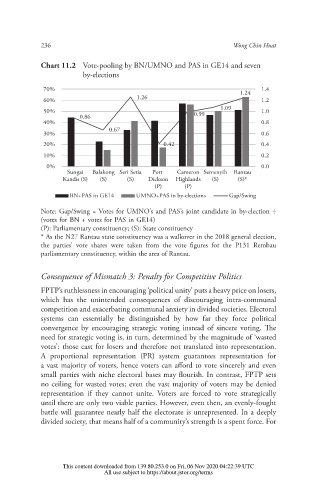
                  Chart 11.2  Vote-pooling by BN/UMNO and PAS in GE14 and seven
                              by-elections
                   70%                                                  1.24  1.4
                                            1.26
                   60%                                                        1.2
                   50%                                             1.09       1.0
                             0.86                           0.99
                   40%                                                        0.8
                                     0.67
                   30%                                                        0.6
                   20%                             0.42                       0.4
                   10%                                                        0.2
                    0%                                                        0.0
                         Sungai  Balakong Seri Setia  Port   Cameron Semenyih  Rantau
                        Kandis (S)  (S)  (S)   Dickson  Highlands  (S)  (S)*
                                                 (P)     (P)
                          BN+PAS in GE14    UMNO+PAS in by-elections  Gap/Swing

                  Note: Gap/Swing = Votes for UMNO’s and PAS’s joint candidate in by-election ÷
                  (votes for BN + votes for PAS in GE14)
                  (P): Parliamentary constituency; (S): State constituency
                  * As the N27 Rantau state constituency was a walkover in the 2018 general election,
                  the  parties’  vote  shares  were  taken  from  the  vote   gures  for  the  P131  Rembau
                  parliamentary constituency, within the area of Rantau.

                  Consequence of Mismatch 3: Penalty for Competitive Politics

                  FPTP’s ruthlessness in encouraging ‘political unity’ puts a heavy price on losers,
                  which has the unintended consequences of discouraging intra-communal
                  competition and exacerbating communal anxiety in divided societies. Electoral
                  systems can essentially be distinguished by how far they force political
                  convergence by encouraging strategic voting instead of sincere voting.  e
                  need for strategic voting is, in turn, determined by the magnitude of ‘wasted
                  votes’: those cast for losers and therefore not translated into representation.
                  A proportional representation (PR) system guarantees representation for
                  a vast majority of voters, hence voters can a ord to vote sincerely and even
                  small parties with niche electoral bases may  ourish. In contrast, FPTP sets
                  no ceiling for wasted votes; even the vast majority of voters may be denied
                  representation if they cannot unite.  Voters are forced to vote strategically
                  until there are only two viable parties. However, even then, an evenly-fought
                  battle will guarantee nearly half the electorate is unrepresented. In a deeply
                  divided society, that means half of a community’s strength is a spent force. For


                        This content downloaded from 139.80.253.0 on Fri, 06 Nov 2020 04:22:39 UTC
                                   All use subject to https://about.jstor.org/terms

