


Page 43 - Towards_a_New_Malaysia_The_2018_Election_and_Its_6146371_(z-lib.org)
P. 43
28                                        Ibrahim Su an and Lee Tai De

                  Voting Patterns by Generation

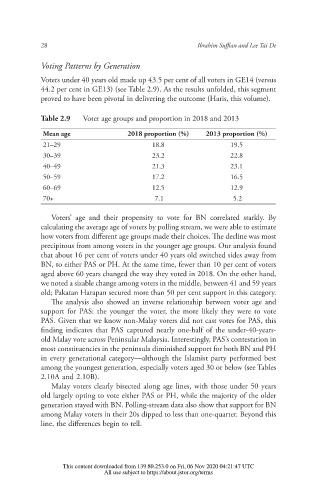
                  Voters under 40 years old made up 43.5 per cent of all voters in GE14 (versus
                  44.2 per cent in GE13) (see Table 2.9). As the results unfolded, this segment
                  proved to have been pivotal in delivering the outcome (Haris, this volume).

                  Table 2.9   Voter age groups and proportion in 2018 and 2013

                   Mean age               2018 proportion (%)  2013 proportion (%)
                   21–29                        18.8                 19.5
                   30–39                        23.2                 22.8
                   40–49                        21.3                 23.1
                   50–59                        17.2                 16.5
                   60–69                        12.5                 12.9
                   70+                           7.1                   5.2

                     Voters’ age and their propensity to vote for BN correlated starkly. By
                  calculating the average age of voters by polling stream, we were able to estimate
                  how voters from di erent age groups made their choices.  e decline was most
                  precipitous from among voters in the younger age groups. Our analysis found
                  that about 16 per cent of voters under 40 years old switched sides away from
                  BN, to either PAS or PH. At the same time, fewer than 10 per cent of voters
                  aged above 60 years changed the way they voted in 2018. On the other hand,
                  we noted a sizable change among voters in the middle, between 41 and 59 years
                  old; Pakatan Harapan secured more than 50 per cent support in this category.
                      e analysis also showed an inverse relationship between voter age and
                  support for PAS: the younger the voter, the more likely they were to vote
                  PAS. Given that we know non-Malay voters did not cast votes for PAS, this
                   nding indicates that PAS captured nearly one-half of the under-40-years-
                  old Malay vote across Peninsular Malaysia. Interestingly, PAS’s contestation in
                  most constituencies in the peninsula diminished support for both BN and PH
                  in every generational category—although the Islamist party performed best
                  among the youngest generation, especially voters aged 30 or below (see Tables
                  2.10A and 2.10B).
                     Malay voters clearly bisected along age lines, with those under 50 years
                  old largely opting to vote either PAS or PH, while the majority of the older
                  generation stayed with BN. Polling-stream data also show that support for BN
                  among Malay voters in their 20s dipped to less than one-quarter. Beyond this
                  line, the di erences begin to tell.


                        This content downloaded from 139.80.253.0 on Fri, 06 Nov 2020 04:21:47 UTC
                                   All use subject to https://about.jstor.org/terms

