


Page 87 - Towards_a_New_Malaysia_The_2018_Election_and_Its_6146371_(z-lib.org)
P. 87
72                                               Helen Ting Mu Hung

                  an independent, who won. Hence for simplicity, we exclude these additional
                  candidates, focusing only on DAP, MCA, and PAS. Only 12 of the 39 seats
                  MCA contested were one-on-one contests between MCA and DAP, while
                  another 12 seats were MCA-DAP-PAS three-cornered contests. MCA faced
                  o  against Keadilan or Bersatu and PAS in its other 15 seats. In all one-on-one
                  contests against MCA, DAP was triumphant, while in three-cornered  ghts,
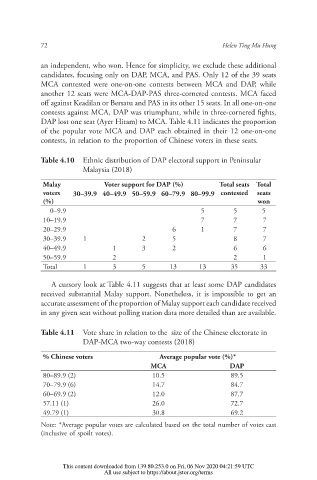
                  DAP lost one seat (Ayer Hitam) to MCA. Table 4.11 indicates the proportion
                  of the popular vote MCA and DAP each obtained in their 12 one-on-one
                  contests, in relation to the proportion of Chinese voters in these seats.

                  Table 4.10  Ethnic distribution of DAP electoral support in Peninsular
                              Malaysia (2018)
                   Malay           Voter support for DAP (%)      Total seats  Total
                   voters   30–39.9 40–49.9 50–59.9 60–79.9 80–99.9  contested  seats
                   (%)                                                       won
                     0–9.9                                   5         5      5
                   10–19.9                                   7         7       7
                   20–29.9                            6      1         7       7
                   30–39.9    1               2       5                8       7
                   40–49.9            1       3       2                6       6
                   50–59.9            2                                2       1
                   Total      1       3       5      13      13       35     33

                     A cursory look at Table 4.11 suggests that at least some DAP candidates
                  received substantial  Malay  support. Nonetheless,  it is  impossible to get an
                  accurate assessment of the proportion of Malay support each candidate received
                  in any given seat without polling station data more detailed than are available.

                  Table 4.11  Vote share in relation to the  size of the Chinese electorate in
                              DAP-MCA two-way contests (2018)
                   % Chinese voters               Average popular vote (%)*
                                                MCA                  DAP
                   80–89.9 (2)                  10.5                 89.5
                   70–79.9 (6)                  14.7                 84.7
                   60–69.9 (2)                  12.0                 87.7
                   57.11 (1)                    26.0                 72.7
                   49.79 (1)                    30.8                 69.2
                  Note: *Average popular votes are calculated based on the total number of votes cast
                  (inclusive of spoilt votes).


                        This content downloaded from 139.80.253.0 on Fri, 06 Nov 2020 04:21:59 UTC
                                   All use subject to https://about.jstor.org/terms

