


Page 90 - Towards_a_New_Malaysia_The_2018_Election_and_Its_6146371_(z-lib.org)
P. 90
Cross-ethnic Vote-pooling in West Malaysia                    75

                     In three-cornered  ghts, when PAS intervened, it can be safely assumed
                  that  its  candidates  attracted  almost  100  per  cent  of  Malay  voters.  In  the
                  absence of a PAS candidate, strongly anti-BN Malay voters would have voted
                  for DAP while those who were strongly anti-DAP would have voted for MCA.
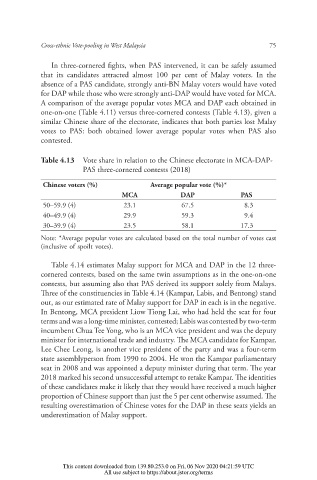
                  A comparison of the average popular votes MCA and DAP each obtained in
                  one-on-one (Table 4.11) versus three-cornered contests (Table 4.13), given a
                  similar Chinese share of the electorate, indicates that both parties lost Malay
                  votes to PAS: both obtained lower average popular votes when PAS also
                  contested.

                  Table 4.13  Vote share in relation to the Chinese electorate in MCA-DAP-
                              PAS three-cornered contests (2018)
                   Chinese voters (%)           Average popular vote (%)*
                                        MCA             DAP             PAS
                   50–59.9 (4)           23.1           67.5             8.3
                   40–49.9 (4)           29.9           59.3             9.4
                   30–39.9 (4)           23.5           58.1            17.3
                  Note: *Average popular votes are calculated based on the total number of votes cast
                  (inclusive of spoilt votes).

                     Table 4.14 estimates Malay support for MCA and DAP in the 12 three-
                  cornered contests, based on the same twin assumptions as in the one-on-one
                  contests, but assuming also that PAS derived its support solely from Malays.
                   ree of the constituencies in Table 4.14 (Kampar, Labis, and Bentong) stand
                  out, as our estimated rate of Malay support for DAP in each is in the negative.
                  In Bentong, MCA president Liow Tiong Lai, who had held the seat for four
                  terms and was a long-time minister, contested; Labis was contested by two-term
                  incumbent Chua Tee Yong, who is an MCA vice president and was the deputy
                  minister for international trade and industry.  e MCA candidate for Kampar,
                  Lee Chee Leong, is another vice president of the party and was a four-term
                  state assemblyperson from 1990 to 2004. He won the Kampar parliamentary
                  seat in 2008 and was appointed a deputy minister during that term.  e year
                  2018 marked his second unsuccessful attempt to retake Kampar.  e identities
                  of these candidates make it likely that they would have received a much higher
                  proportion of Chinese support than just the 5 per cent otherwise assumed.  e
                  resulting overestimation of Chinese votes for the DAP in these seats yields an
                  underestimation of Malay support.


                        This content downloaded from 139.80.253.0 on Fri, 06 Nov 2020 04:21:59 UTC
                                   All use subject to https://about.jstor.org/terms

