Page 108 - Elementary Algebra Exercise Book I
P. 108
ELEMENTARY ALGEBRA EXERCISE BOOK I                                             inequAlities


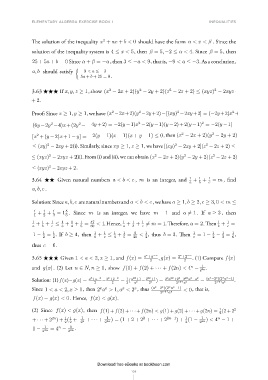
               The solution of the inequality x + ax + b< 0 should have the form α <x < β . Since the
                                               2
               solution of the inequality system is 4 ≤ x< 5, then  β =5, −2 ≤ α< 4. Since  β =5, then

               25 + 5a + b =0 Since α + β = −a , then 3 ≤−a< 9, that is, −9 <a ≤−3. As a conclusion,

               a, b  should satisfy      −9 <a ≤−3
                                     5a + b + 25 = 0.


                                                 2
                                                               2
                                                                            2
                                                                                                2
               3.63     If x,y,z ≥ 1, show  (x − 2x + 2)(y − 2y + 2)(z − 2z + 2) ≤ (xyz) − 2xyz +2
 (x − 2x + 2)(y − 2y + 2)(z − 2z + 2) ≤ (xyz) − 2xyz +2.
      2
 2
 2
 2
                                                   2           2                2                       2          2           2
               Proof: Since x ≥ 1,y ≥ 1, we have (x −2x+2)(y −2y+2)−[(xy) −2xy+2] = (−2y+2)x +(6y−2y −4)x+(2y −

                                               2
                                                                                                                 2
                                                                                                                             2
                                                                             2
                                                            2
                                                                                                      2
                                             (x −2x+2)(y −2y      2 +2)−[(xy) −2xy+2] = (−2y+2)x +(6y−2y −4)x+(2y −
                                                                                                             2
                                                                                             2
                                             4y +2) = −2(y −1)x −2(y −1)(y −2)+2(y −1) = −2(y −1)[x +(y −2)x+1−y]=
                                                          2
                                                                                                                 2
                                                                            2
                                                                                                     2
                                                                                                                             2
                                              2
                                                                                                          2
                                                               2 2y+2)−[(xy) −2xy+2] = (−2y+2)x +(6y−2y −4)x+(2y −
                                                                                           2
                                            (x −2x+2)(y −
 2  2  2    2           2           2     4y +2) = −2(y −1)x −2(y −1)(y −2)+2(y −1) = −2(y −1)[x +(y −2)x+1−y]=
 (x −2x+2)(y −2y+2)−[(xy) −2xy+2] = (−2y+2)x +(6y−2y −4)x+(2y −     −2(y − 1)(x − 1)(x + y − 1) ≤ 0  2      2
                                                              2
 2
                                    2
                        2
 2
             2
 2
 2 −2y+2)−[(xy) −2xy+2] =
 (x −2x+2)(y
                                          −2(y − 1)(x − 1)(x + y − 1) ≤ 0
                 2
 2(−2y+2)x +(6y−2y −4)x+(2y −
 4y +2) = −2(y −1)x −2(y −1)(y −2)+2(y −1) = −2(y −1)[x +(y −2)x+1−y]=  4y +2) = −2(y −1)x −2(y −1)(y −2)+2(y −1) = −2(y −1)[x +(y −2)x+1−y]=

                                                                                               2
                                                                                  2
                                                                                                                  2
 2
 4y +2) = −2(y −1)x −2(y −1)(y −2)+2(y −1) = −2(y −1)[x +(y −2)x+1−y]=
 −2(y − 1)(x − 1)(x + y − 1) ≤ 0  2  2    −2(y − 1)(x − 1)(x + y − 1) ≤ 0, then (x − 2x + 2)(y − 2y + 2) ≤ (xy) − 2xy +2
 −2(y − 1)(x − 1)(x + y − 1) ≤ 0

                                                                               2
                      2
    2
                                                                                                                2
 2
                                                                                             2
 (x − 2x + 2)(y − 2y + 2) ≤ (xy) − 2xy +2(i). Similarly, since xy ≥ 1,z ≥ 1, we have [(xy) − 2xy + 2](z − 2z + 2) ≤ (xyz) − 2xyz +2
    2
                                                                      2
                                                                                   2
                       2
 2
                                                                                                                   2
                                                                                                2
 [(xy) − 2xy + 2](z − 2z + 2) ≤ (xyz) − 2xyz +2 (ii). From (i) and (ii), we can obtain (x − 2x + 2)(y − 2y + 2)(z − 2z + 2) ≤ (xyz) − 2xyz +2

 (x − 2x + 2)(y − 2y + 2)(z − 2z + 2) ≤ (xyz) − 2xyz +2.
 2
    2
                       2
 2
                                                                                         1
                                                                                     1
               3.64     Given natural numbers  a<b< c ,  m  is an integer, and  + +           1  = m , find
                                                                                     a   b    c
               a, b, c .
                                                                                                           1   1   1     5
               Solution: Since a, b, c  are natural numbers and a<b< c , we have a ≥ 1,b ≥ 2,c ≥ 3, 0 <m ≤  +    +   =1
                                                                                                           1   2   3     6
                1   1    1    5
 a ≥ 1,b ≥ 2,c ≥ 3, 0 <m ≤  +  +  =1 . Since  m  is an integer, we have  m =1  and  a  =1 . If  a ≥ 3 , then
                1   2    3    6
                                                                                                  1
                                                            1
                                                        1
               1  + +   1   1  + +   1  =  47  < 1. Hence,  + +  1   = m =1. Therefore, a =2. Then  +  1      1  =  1
                    1
                                 1
               a    b   c  ≤  3  4   5   60             a   b   c                                 b   c  =1 −  2   2
       1  +  1      1  = .  If  b ≥ 4,  then  +  1  1  +  1  =  9  1                   1       1    1  = ,
                                           1
                         1
                                                                                                        1
       b    c  =1 −  2   2                 b   c  ≤  4  5   20  < ,  thus  b =3.  Then  =1 − −      3   6
                                                                                       c
                                                                                               2
                                                                  2
               thus  c =6.
                                                                  x
                                                                                 x
               3.65     Given 1 <a < 2,x ≥ 1, and f(x) =         a +a −x  ,g(x)=  2 +2 −x . (1) Compare f(x)
                                                                    2              2
                                                                                           m .
                                                                                      n    1 1
               and  g(x). (2) Let  n ∈ N, n ≥ 1, show  f(1) + f(2) + ··· + f(2n) < 4 −     2n
                                                                                          2 2
                                                                                                 x
                                                                                              x
                                                                                                    x x
                                                 x
                                                                           x 2x
                                         x
                                                                                x
                                                                                     a −a
                                                                    +1
                                                         1 a
               Solution: (1)f(x)−g(x) =  a +a −x  − 2 +2 −x  = (  2x +1  2 2x x ) =  2 a  +2 −2 2x x  x  =  (a −2 )(2 a −1) .
                                           2       2     2   a x −  2          2 x+1 x          2 x+1 x
                                                                                                    a
                                                                                   a
                                                                      x
                                                                            x x
               Since  1 <a < 2,x ≥ 1, then  2 a > 1,a < 2 , thus    (a −2 )(2 a −1)  < 0 , that is,
                                                                         x
                                             x x
                                                       x
                                                             x
                                                                            a
                                                                        2 x+1 x
                f(x) − g(x) < 0. Hence,  f(x) <g(x).
                                                                                                                   2n
                                                                                                                        1 1
                                                                                                   1
                                                                                                         2
               (2) Since  f(x) <g(x), then  f(1) + f(2) + ···+ f(2n) <g(1) + g(2) + ···+ g(2n)= (2 + 2 + ···+2 )+ ( +
                                                                                                                       1 1
                                                                                                1
                                                                                                                 2n
                                                                                                       2
                                        f(1) + f(2) + ···+ f(2n) <g(1) + g(2) + ···+ g(2n)=     2  2 (2 + 2 +  ···+2 )+ ( 2 2+
                                           1
                                                                                                                      n 2 2
                                                                                      1
                                                                                                                           1
                                                                                             1
                                                     1
                                                                                                                1
                                                                               2n−1
                                                                                                    n
                                                                     2
                                           2 + ··· +
                                                     2n ) = (1 +2 +2 + ··· +2
       1
                                                                                                                2n =4 − 1
              2
                                                                                                                     n
                                                                                   )+ (1 − 1
                                                                                   1
                              1 1
                                                                 2
                                                                                             2n ) < 4 − 1 +1 − 1
                                                                                                  n
                        2n
 f(1) + f(2) + ···+ f(2n) <g(1) + g(2) + ···+ g(2n)= (2 + 2 + ···+2 )+ ( +  1 2 +  2 ··· +  1 2n )  2 = (1 +2 +2 + ··· +2 2n−1 )+ (1 2 −  2 ) < 4 − 1 +1 −  2 =4 −  2 2n
      1
                             1 1
                       2n
             2
 f(1) + f(2) + ···+ f(2n) <g(1) + g(2) + ···+ g(2n)=  2 (2 + 2 + ···+2 )+ ( +    2  2  2  2 2n                2 2n        2 2n
                              2 2
 1  1  2  2n−1  1  1  2  n  1  n 2 2  1
 2 + ··· + 1
 )+ (1 − 1
 2n ) = (1 +2 +2 + ··· +2 2n−1
 2
                           n
       n
 1 2 + ··· +  2 ) = (1 +2 +2 + ··· +2  )+  1  2n ) < 4 − 1 +1 − 1 2n =4 − 1 2 .
                                 2n
                     2 =4 −
 2 ) < 4 − 1 +1 −
 2 2  2 2n  2  2 (1 −  2 2n  2 2n  2 2n
                                            Download free eBooks at bookboon.com
                                                           108
   103   104   105   106   107   108   109   110   111   112   113