


Page 110 - Elementary Algebra Exercise Book I
P. 110
ELEMENTARY ALGEBRA EXERCISE BOOK I                                             inequAlities


                                                             2
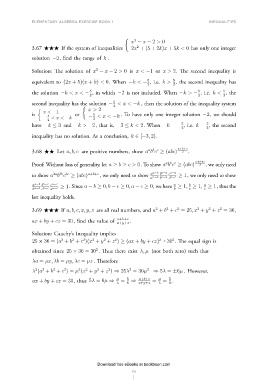
                                                           x − x − 2 > 0
               3.67     If the system of inequalities      2x +(5+2k)x +5k< 0 has only one integer
                                                              2
               solution  −2, find the range of  k .


               Solution: The solution of  x − x − 2 > 0 is  x< −1 or  x> 2. The second inequality is
                                            2
               equivalent to  (2x + 5)(x + k) < 0. When  −k< − , i.e.  k> , the second inequality has
                                                                   5
                                                                              5
                                                                   2          2
                                                                                                    5
                                         5
               the solution  −k <x < − , in which  −2 is not included. When  −k> − , i.e.  k< , the
                                                                                         5
                                         2                                               2          2
               second inequality has the solution − <x< −k , then the solution of the inequality system
                                                   5
                                                   2
                                        x> 2
               is   x< −1         or    − <x < −k      . To have only one integer solution  −2, we should
                                          5
                      5
                    − <x < −k             2
                      2
                                                                                             5
               have  −k ≤ 3 and  −k> −2, that is,  −3 ≤ k< 2. When  −k = − , i.e.  k = , the second
                                                                                  5
                                                                                  2          2
               inequality has no solution. As a conclusion,  k ∈ [−3, 2).
                                                                                  3 .
                                                                   a b c
               3.68     Let  a, b, c  are positive numbers, show  a b c ≥ (abc)  a+b+c
                                                                                          3 , we only need
                                                                           a b c
               Proof: Without loss of generality, let a ≥ b ≥ c> 0. To show a b c ≥ (abc)  a+b+c
                                                                             b−c ≥ 1, we only need to show
                         3a 3b 3c
               to show a b c ≥ (abc)    a+b+c , we only need to show   a a−b  b b−a  c c−a
                                                                    a c−a  b c−a  c
               a a−b  b b−c  c  a−c                                           a      b      a  ≥ 1, thus the
                        a−c ≥ 1. Since a − b ≥ 0,b − c ≥ 0,a − c ≥ 0, we have  ≥ 1, ≥ 1,
               b a−b  c b−c  a                                                b      c      c
               last inequality holds.
                                                                                              2
                                                                           2
                                                                                                   2
                                                                      2
                                                                                2
                                                                                         2
               3.69     If a,b,c,x,y,z  are all real numbers, and a + b + c = 25,x + y + z = 36, ax + by + cz = 30

                                                     a+b+c
 a + b + c = 25,x + y + z = 36, ax + by + cz = 30, find the value of   x+y+z .
   2
 2
 2
        2
 2
 2
               Solution: Cauchy’s Inequality implies
               25 × 36 = (a + b + c )(x + y + z ) ≥ (ax + by + cz) = 30× 36 = (a + b + c )(x + y + z ) ≥ (ax + by + cz) = 30 . The equal sign is
               25           2 2  2 2  2 2  2 2  2 2  2 2                2 2     2 2
               obtained since  25 × 36 = 30 . Thus there exist  λ, μ  (not both zero) such that
                                            2
               λa = μx, λb = μy, λc = μz . Therefore
                                       2 2
                                    2 2
                             2 2
               λ (a + b + c )= μ (x + y + z ) ⇒ 25λ = 36μ ⇒ 5λ = ±6μλ (a + b + c )= μ (x + y + z ) ⇒ 25λ = 36μ ⇒ 5λ = ±6μ . However,
                 2 2
                         2 2
                    2 2
                                                 2 2
                                                          2 2
                                            2 2
                                                                  2 2

                                                     μ   5     a+b+c   μ    5
               ax + by + cz = 30, thus  5λ =6μ ⇒     λ  =  6  ⇒  x+y+z  =  λ  = .
                                                                            6


                                            Download free eBooks at bookboon.com
                                                            110

