


Page 21 - Elementary Algebra Exercise Book I
P. 21
ELEMENTARY ALGEBRA EXERCISE BOOK I                                           reAl numBers


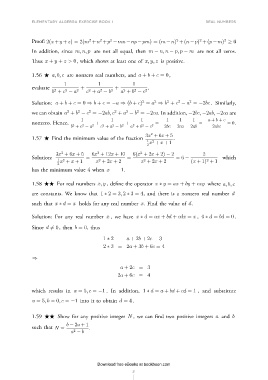
               Proof:   2(x+y +z)=2(m +n +p −mn−np−pm) =(m−n) +(n−p) +(p−m) ≥ 0 .
                                             2
                                                                                          2
                                                                                                     2
                                         2
                                                  2
                                                                               2

               In addition, since  m, n, p  are not all equal, then  m − n, n − p, p − m  are not all zeros.
               Thus  x + y + z> 0, which shows at least one of  x,y,z  is positive.
               1.56     a, b, c  are nonzero real numbers, and  a + b + c =0,

                              1              1              1
               evaluate              +              +              .
                                        2
                                                             2
                                                        2
                              2
                                             2
                         2
                        b + c − a  2   c + a − b  2    a + b − c  2
                                                                                2
                                                                                     2
               Solution:  a + b + c =0 ⇒ b + c = −a ⇒ (b + c) = a ⇒ b + c − a = −2bc . Similarly,
                                                                           2
                                                                2
                                                                      2
                               2
                                    2
                                         2
                                                              2
               we can obtain a + b − c = −2ab, c + a − b = −2ca. In addition, −2bc, −2ab, −2ca are
                                                    2
                                                         2
                                     1            1             1          1     1     1     a + b + c
                 nonzero. Hence,           +             +            = −    −     −     = −          =0.
                                                   2
                                               2
                                                                2
                                                            2
                                      2
                                 2
                                b + c − a 2   c + a − b 2  a + b − c 2    2bc   2ca   2ab      2abc
                                                                    2
               1.57    Find the minimum value of the fraction     3x +6x +5   .
                                                                  1 x + x +1
                                                                     2
                                                                  2
                            2
                                            2
                                                               2
                          3x +6x +5       6x + 12x + 10     6(x +2x + 2) − 2               2
               Solution:   1  2        =     2           =       2             =6 −          2      which
                           2 x + x +1       x +2x +2            x +2x +2              (x + 1) +1
               has the minimum value 4 when  x = −1.
               1.58     For real numbers  x, y , define the operator  x ∗ y = ax + by + cxy  where  a, b, c
               are   constants. We know that  1 ∗ 2 =3, 2 ∗ 3= 4, and there is a nonzero real number  d
               such that  x ∗ d = x  holds for any real number  x. Find the value of  d.
               Solution: For any real number  x , we have  x ∗ d = ax + bd + cdx = x ,  0 ∗ d = bd =0.
               Since  d  =0, then  b =0, thus
                                               1 ∗ 2= a +2b +2c =3
                                               2 ∗ 3 =2a +3b +6c =4
               ⇒
                                                      a +2c =3
                                                     2a +6c =4


               which results in  a =5,c = −1 . In addition,  1 ∗ d = a + bd + cd =1 , and substitute
               a =5,b =0,c = −1 into it to obtain  d =4.


               1.59     Show for any positive integer  N , we can find two positive integers  a  and  b
                               b − 2a +1
               such that  N =            .
                                 a − b
                                  2


                                            Download free eBooks at bookboon.com
                                                            21

