Page 24 - Elementary Algebra Exercise Book I
P. 24
ELEMENTARY ALGEBRA EXERCISE BOOK I                                           reAl numBers


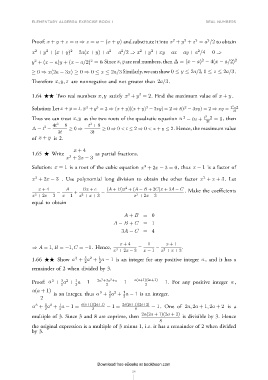
               Proof: x + y + z = a ⇒ z = a − (x + y) and substitute it into x + y + z = a /2 to obtain
                                                                              2
                                                                                        2
                                                                                   2
                                                                                             2
                 2    2         2                 2    2       2    2                    2
               x + y + (x + y) − 2a(x + y)+ a = a /2 ⇒ x + y + xy − ax − ay + a /4= 0 ⇒
                                                                        2
                                                                   2
                                                     2
                         2
                    2
                                    2
                                                                                            2
                                                          2
                   x + y + (x + y) − 2a(x + y)+ a = a /2 ⇒ x + y + xy − ax − ay + a /4= 0 ⇒
                                      2
             2
            y +(x − a)y +(x − a/2) =0
                                                                                           2
                                                                                                         2
               y +(x − a)y +(x − a/2) =0. Since x, y are real numbers, then Δ=(x − a) − 4(x − a/2) ≥ 0 ⇒ x(2a − 3x) ≥ 0 ⇒ 0 ≤ x ≤ 2a/3
                                         2
                2
 Δ=(x − a) − 4(x − a/2) ≥ 0 ⇒ x(2a − 3x) ≥ 0 ⇒ 0 ≤ x ≤ 2a/3 . Similarly, we can show 0 ≤ y ≤ 2a/3, 0 ≤ z ≤ 2a/3.
             2
 2
                                                                                                          
               Therefore  x,y,z  are nonnegative and not greater than  2a/3.
               1.64     Two real numbers  x, y  satisfy  x + y =2. Find the maximum value of  x + y .
                                                          3
                                                               3
                                                                                                         .
                                                                                                        3
                                  a,
                                                                                   2
                                       3
                                            3
                                                                  2
               Solution: Let x + y = t.  b, x + y =2 ⇒ (x + y)[(x + y) − 3xy]= 2 ⇒ t(t − 3xy)=2 ⇒ xy =  t −2
                                                                                                         3t
                                                                                      3
                                                                                     t −2
                                                                            2
                                                                                            3
                                                                                          =0
                                                                                  2
               Thus we can treat x, y  as the two roots of the quadratic equation  tu + − tu +  t −2  =0, then
                                                                             −
                                                                                      3t     3t
                          3
                                         3
                        4t − 8         −t +8
                     2
               Δ= t −           ≥ 0 ⇒         ≥ 0 ⇒ 0 <t ≤ 2 ⇒ 0 <x + y ≤ 2. Hence, the maximum value
                           3t            3t
               of  x + y  is 2.
                                  x +4
               1.65    Write                as partial fractions.
                                3
                               x +2x − 3
               Solution:  x =1 is a root of the cubic equation  x +2x − 3 =0, thus  x − 1 is a factor of
                                                                 3
               x +2x − 3 .  Use  polynomial  long  division to  obtain the other factor  x + x +3.  Let
                 3
                                                                                           2
                            
                                                         2
                  x +4        A       Bx + c    (A + B)x +(A − B +2C)x +3A − C     . Make the coefficients
                          =       +           =
                                                              3
                 3
               x +2x − 3     x − 1  x + x +3                x +2x − 3
                                     2
               equal to obtain
                                                        A + B =0
                                                   A − B + C =1
                                                       3A − C =4
                                                      x +4         1       x +1
               ⇒ A =1,B = −1,C = −1. Hence,                   =       −           .
                                                     3
                                                                          2
                                                   x +2x − 3     x − 1   x + x +3
               1.66     Show  a + a + a − 1 is an integer for any positive integer  a , and it has a
                                             1
                                   3
                                       3 2
                                       2     2
               remainder of 2 when divided by 3.
                                                  2
                                              3
                        3
                                   1
                            3 2
               Proof:  a + a + a − 1=       2a +3a +a  − 1=  a(a+1)(2a+1)  − 1. For any positive integer  a ,
                            2      2            2                 2
               a(a + 1)
                         is an integer, thus  a + a + a − 1 is an integer.
                                                        1
                                             3
                                                 3 2
                   2                             2      2
                 3
                     3 2
                           1
               a + a + a − 1=        a(a+1)(2a+1)  − 1=  2a(2a+1)(2a+2)  − 1. One of  2a, 2a +1, 2a +2 is a
                     2     2              2                  8
               multiple of 3. Since 3 and 8 are coprime, then   2a(2a + 1)(2a + 2)  is divisible by 3. Hence
                                                                        8
               the original expression is a multiple of 3 minus 1, i.e. it has a remainder of 2 when divided
               by 3.
                                            Download free eBooks at bookboon.com
                                                            24
   19   20   21   22   23   24   25   26   27   28   29