


Page 23 - Elementary Algebra Exercise Book I
P. 23
ELEMENTARY ALGEBRA EXERCISE BOOK I                                           reAl numBers


                                                                               b + c    b + b
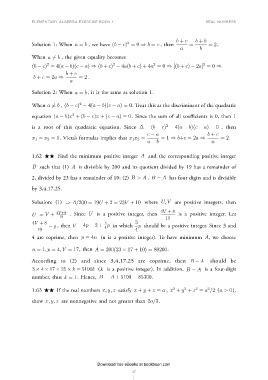
               Solution 1: When  a = b , we have  (b − c) =0 ⇒ b = c , then          =        =2.
                                                          2
                                                                                 a        b
               When  a  = b , the given equality becomes
                      2                            2                 2                     2
                          2
                                                       2
                                                                                               2
                                                                         2
               (b − c) = 4(a − b)(c − a) ⇒ (b + c) − 4a(b + c) +4a =0 ⇒ [(b + c) − 2a] =0 ⇒
                   (b − c) = 4(a − b)(c − a) ⇒ (b + c) − 4a(b + c) +4a =0 ⇒ [(b + c) − 2a] =0 ⇒
                          b + c b + c
            b + c =2a ⇒         =2  =2 .
                            a
                b + c =2a ⇒     a
               Solution 2: When  a = b, it is the same as solution 1.
               When a  = b , (b − c) − 4(a − b)(c − a)=0. Treat this as the discriminant of the quadratic
                                    2
                 equation  (a − b)x +(b − c)x +(c − a) =0. Since the sum of all coefficients is 0, then 1
                                 2
               is a root of this quadratic equation. Since  Δ=(b − c) − 4(a − b)(c − a) =0 , then
                                                                           2
                                                                   (
                                                                         )
                                                                                            )
                                                                                     )(
                                                                               (
                                                                  c − a                      b + c
               x 1 = x 2 =1. Vieta’s formulas implies that  x 1 x 2 =   =1 ⇒ b+c =2a ⇒             = 2.
                                                                  a − b                        a
               1.62     Find the minimum positive integer  A  and the corresponding positive integer
               B  such that (1)  A  is divisible by 200 and its quotient divided by 19 has a remainder of

               2, divided by 23 has a  remainder of 10; (2) B >A , B − A  has four digits and is divisible

               by 3,4,17,25.


               Solution: (1)  ⇒ A/200 = 19U + 2 = 23V + 10  where  U, V  are positive integers, then


               U, V   = V +  4V +8   . Since  U  is a positive integer, then   4V +8  is a positive integer. Let
                           19
                                                                          19
                                                             3
               4V +8   = p , then V =4p − 2+ p  in which  p  should be a positive integer. Since 3 and
                                                3
                               U,
                  19                            4            4
               4 are coprime, then  p =4n  (n is a positive   integer). To have minimum  A, we choose
               n =1,p =4,V = 17, then  A = 200(23 × 17 + 10) = 80200.

               According to (2) and since 3,4,17,25 are coprime, then  B − A  should be

               3 × 4 × 17 × 25 × k = 5100k  (k  is a positive integer). In addition,  B − A  is a four-digit
               number, thus  k =1. Hence,  B = A + 5100 = 85300.

               1.63    If the real numbers  x,y,z  satisfy x + y + z = a , x + y + z = a /2 (a> 0),
                                                                                        2
                                                                                   2
                                                                                             2
                                                                              2
               show  x,y,z  are nonnegative and not greater than  2a/3.


                                            Download free eBooks at bookboon.com
                                                            23

