


Page 27 - Elementary Algebra Exercise Book I
P. 27
ELEMENTARY ALGEBRA EXERCISE BOOK I                                           reAl numBers


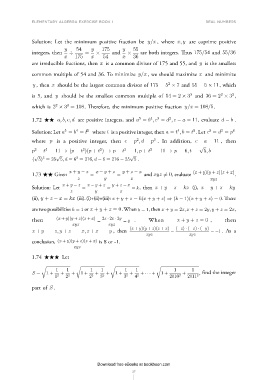
               Solution: Let the minimum positive fraction be  y/x , where  x, y  are coprime positive
                              y    54     y   175      y    55
               integers, then   ÷      =    ×      and    ×     are both integers. Thus 175/54 and 55/36
                              x   175     x    54      x    36
               are irreducible fractions, then x  is a common divisor of 175 and 55, and  y  is the smallest

               common multiple of 54 and 36. To minimize  y/x , we should maximize  x  and minimize

                y , then x  should be the largest common divisor of 175 = 5 × 7 and 55 = 5 × 11, which
                                                                            2
               is 5, and  y  should be the smallest common multiple of  54 = 2 × 3  and  36 = 2 × 3 ,
                                                                                                        2
                                                                                     3
                                                                                                   2
               which is  2 × 3 = 108. Therefore, the minimum positive fraction  y/x = 108/5.
                               3
                          2
               1.72      a, b, c, d  are positive integers, and  a = b ,c = d ,c − a = 11, evaluate  d − b .
                                                               5
                                                                    4
                                                                       3
                                                                            2
                                        2 0
               Solution: Let a = b = t 0    where t  is a positive integer, then a = t ,b = t . Let c = d = p
                              5
                                                                                              3
                                                                                                   2
                                                                                                        6
                                   4
                                                                                4
                                                                                       5
               where  p  is a positive integer, then  c = p ,d = p . In addition,  c − a = 11 , then
                                                              2
                                                                     3
                                                                                          √
                                      2
                2
                                             2
                                                                    2
                                                        2
                     4
               p − t = 11 ⇒ (p − t )(p + t ) ⇒ p − t =1,p + t = 11 ⇒ p =6,t =            √  5,b =
                                        2
                                               2
                    2
                                                         2
                                                                    2
                        4
             √     p − √ t = 11 ⇒ (p − t )(p + t ) ⇒ p − t =1,p + t = 11 ⇒ p =6,t =        5,b =
                                                          √
                                3
                 5 √
                                                           √
                          √
            ( 5) = 25 5,d =6 = 216,d − 6 = 216 − 25 5
               ( 5) = 25 5,d =6 = 216,d − 6 = 216 − 25 5 .
                    5
                                   3
               1.73    Given    x + y − z  =  x − y + z  =  y + z − x  and xyz  =0, evaluate   (x + y)(y + z)(z + x) .
                                    z          y           x                                  xyz
               Solution: Let   x + y − z  =  x − y + z  =  y + z − x  = k, then  x + y − z = kz  (i),  x − y + z = ky
                                z          y          x
               (ii), y + z − x = kx  (iii). (i)+(ii)+(iii): x + y + z = k(x + y + z) ⇒ (k − 1)(x + y + z)=0. There
               are two possibilities k =1 or x + y + z =0. When k =1, then x + y =2z, x + z =2y, y + z =2x,
               then       (x + y)(y + z)(z + x)  =  2z · 2x · 2y  =8  .  When   x + y + z =0 ,       then
                                 xyz             xyz
               x + y = −z, y + z = −x, z + x = −y , then   (x + y)(y + z)(z + x)  =  (−z) · (−x) · (−y)  = −1 . As a
                                                                  xyz                xyz
               conclusion,   (x + y)(y + z)(z + x)  is 8 or -1.
                                  xyz
               1.74      Let

                          1    1         1    1         1    1                1       1
               S =    1+    +    +   1+    +    +   1+     +   + ··· +   1+       +      , find the integer
                         1 2  2 2        2 2  3 2       3 2  4 2            2010 2  2011 2
               part of  S .


                                            Download free eBooks at bookboon.com
                                                            27

