


Page 89 - Elementary Algebra Exercise Book I
P. 89
ELEMENTARY ALGEBRA EXERCISE BOOK I                                               equAtions


                               2
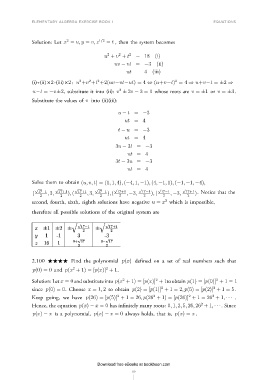
               Solution: Let  x = u, y = v, z 1/2  = t , then the system becomes

                                                      2
                                                 2
                                               u + v + t  2  = 18 (i)
                                                    uv − vt = −3 (ii)
                                                         ut = 4 (iii)

                                    2
                                        2
                                            2
                                                                               2
               (i)+(ii)×2-(iii)×2:  u +v +t +2(uv−vt−ut) =4 ⇔ (u+v−t) =4 ⇒ u+v−t = ±2 ⇒ u−t = −v±2
 u +v +t +2(uv−vt−ut) =4 ⇔ (u+v−t) =4 ⇒ u+v−t = ±2 ⇒ u−t = −v±2, substitute it into (ii):  v ± 2v − 3= 0 whose roots are  v = ±1 or  v = ±3.
 2
 2
 2
 2
                                                      2
                 Substitute the values of  v  into (ii)(iii):
                                                      u − t = −3
                                                        ut =4
                                                      t − u = −3
                                                        ut =4

                                                    3u − 3t = −3
                                                          ut =4
                                                    3t − 3u = −3
                                                          ut =4


               Solve them to obtain (u,v,t)=(1, 1, 4), (−4, 1, −1), (4, −1, 1), (−1, −1, −4),
                   (u,v,t)=(1, 1, 4), (−4, 1, −1), (4, −1, 1), (−1, −1, −4),     √       √          √
                   (u,v,t)=(1, 1, 4), (−4, 1, −1), (4, −1, 1), (−1, −1, −4),
                                                                      √
                                            √
                                                             √
                                   √
                                                    √
                 √ √      √ √     ( √ √  17−1 , 3,  √ √  17+1 ), ( √ √  17+1 , 3,  17−1 ), (  17+1 , −3,  17−1 ), (  17−1 , −3,  17+1 )
                                                                       √ √
                                                               √ √
                                                                                  √ √
                                                                17−1
                                                     17+1
                                    17+1
                  17−1
                           17+1
                                                                                   17+1
                                             17−1
                                                                         17−1
                                                                                                       2
                                                       2
                                                         , −3,
                                                                             , −3,
                                                                    ), ( (
                                                                                            2
               ( (  17−1 , 3, 3,  17+1 ),  17+1 , , 3, 3,  17−1 ),  17+1 , −3,  2 17−1 ),  2 17−1 , −3,  2 17+1 ) ) . Notice that the
                                     2
                               ), ( (
                      ,
                                              2
                                                 ), ( (
                   2 2      2 2     2 2      2 2      2 2        2 2      2 2       2 2
               second, fourth, sixth, eighth solutions have negative  u = x  which is impossible,
                                                                          2
               therefore all possible solutions of the original system are
               2.100       Find the polynomial  p(x) defined on a set of real numbers such that
                                                2
                                 2
                p(0) = 0 and  p(x + 1) = [p(x)] +1.
                                                                                                 2
                                                                      2
                                                       2
               Solution: Let x =0 and substitute into p(x + 1) = [p(x)] +1  to obtain p(1) = [p(0)] +1 = 1
               since  p(0) = 0. Choose  x =1, 2 to obtain  p(2) = [p(1)] +1 = 2,p(5) = [p(2)] +1 = 5.
                                                                                                2
                                                                         2
                                                                                     2
                                                                                               2
               Keep going, we have  p(26) = [p(5)] + 1 = 26,p(26 + 1) = [p(26)] + 1 = 26 +1, ··· .
                                                     2
                                                                     2
               Hence, the equation  p(x) − x =0 has infinitely many roots: 0, 1, 2, 5, 26, 26 +1, ···. Since
                                                                                          2
                p(x) − x  is a polynomial,  p(x) − x =0 always holds, that is,  p(x) = x .
                                            Download free eBooks at bookboon.com
                                                            89

