


Page 92 - Elementary Algebra Exercise Book I
P. 92
ELEMENTARY ALGEBRA EXERCISE BOOK I                                             inequAlities


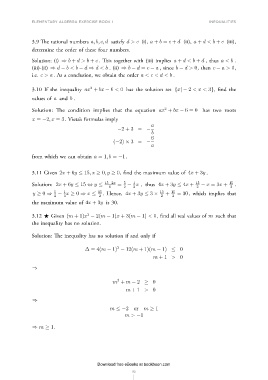
               3.9 The rational numbers a, b, c, d  satisfy d >c  (i), a + b = c + d  (ii), a + d< b + c  (iii),
               determine the order of these four numbers.

               Solution: (i)  ⇒ b + d >b + c . This together with (iii) implies  a + d< b + d , thus  a<b .
               (iii)-(ii)  ⇒ d − b< b − d ⇒ d< b . (ii)  ⇒ b − d = c − a , since  b − d> 0, then  c − a> 0,
               i.e.  c>a . As a conclusion, we obtain the order  a<c < d<b .


                                         2
               3.10 If the inequality  ax + bx − 6 < 0 has the solution set  {x|− 2 < x< 3}, find the
               values of  a  and  b .


                                                                          2
               Solution: The condition implies that the equation  ax + bx − 6 =0  has two roots
               x = −2,x =3. Vieta’s formulas imply
                                                                    a
                                                     −2 +3 = −
                                                                    b
                                                                    6
                                                   (−2) × 3= −
                                                                    a
               from which we can obtain  a =1,b = −1.


               3.11 Given  2x +6y ≤ 15,x ≥ 0,y ≥ 0, find the maximum value of  4x +3y .

                                                15−2x   5   1                           15             15
               Solution:  2x +6y ≤ 15 ⇔ y ≤          =    − x , thus  4x +3y ≤ 4x +       − x =3x +      .
                                                  6     2   3                           2              2
                         5   1               15                         15   15
                y ≥ 0 ⇒    − x ≥ 0 ⇒ x ≤       . Hence,  4x +3y ≤ 3 ×      +    = 30, which implies that
                         2   3               2                          2     2
               the maximum value of  4x +3y  is 30.

               3.12   Given (m + 1)x − 2(m − 1)x + 3(m − 1) < 0, find all real values of m  such that
                                        2
               the inequality has no solution.

               Solution: The inequality has no solution if and only if


                                                     2
                                       Δ=4(m − 1) − 12(m + 1)(m − 1) ≤ 0
                                                                     m +1 > 0

               ⇒


                                                     2
                                                   m + m − 2 ≥ 0
                                                         m +1 > 0
               ⇒

                                                  m ≤−2 or m ≥ 1
                                                        m> −1

               ⇒ m ≥ 1.


                                            Download free eBooks at bookboon.com
                                                            92

