


Page 142 - Basic Principles of Textile Coloration
P. 142
WATER QUALITY FOR THE DYEHOUSE 131

calcium and magnesium ions and gives an immediate precipitate with soap. Soap is
a water-soluble sodium salt of a high molecular weight carboxylic acid, such as
stearic acid. Its calcium and magnesium salts are much less soluble and give a
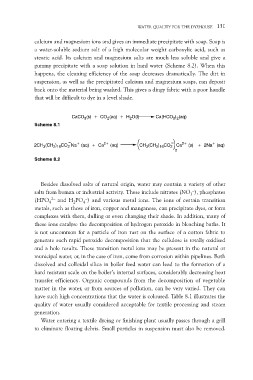
gummy precipitate with a soap solution in hard water (Scheme 8.2). When this
happens, the cleaning efficiency of the soap decreases dramatically. The dirt in
suspension, as well as the precipitated calcium and magnesium soaps, can deposit
back onto the material being washed. This gives a dingy fabric with a poor handle
that will be difficult to dye in a level shade.

            CaCO3(s) + CO2(aq) + H2O(l)  Ca(HCO3)2(aq)

Scheme 8.1

2CH3(CH2)16CO2 Na+ (aq) + Ca2+ (aq)      CH3(CH2)16CO2 Ca2+ (s) + 2Na+ (aq)
Scheme 8.2
                                                                      2

   Besides dissolved salts of natural origin, water may contain a variety of other
salts from human or industrial activity. These include nitrates (NO3–), phosphates
(HPO42– and H2PO4–) and various metal ions. The ions of certain transition
metals, such as those of iron, copper and manganese, can precipitate dyes, or form
complexes with them, dulling or even changing their shade. In addition, many of
these ions catalyse the decomposition of hydrogen peroxide in bleaching baths. It
is not uncommon for a particle of iron rust on the surface of a cotton fabric to
generate such rapid peroxide decomposition that the cellulose is totally oxidised
and a hole results. These transition metal ions may be present in the natural or
municipal water, or, in the case of iron, come from corrosion within pipelines. Both
dissolved and colloidal silica in boiler feed water can lead to the formation of a
hard resistant scale on the boiler’s internal surfaces, considerably decreasing heat
transfer efficiency. Organic compounds from the decomposition of vegetable
matter in the water, or from sources of pollution, can be very varied. They can
have such high concentrations that the water is coloured. Table 8.1 illustrates the
quality of water usually considered acceptable for textile processing and steam
generation.

   Water entering a textile dyeing or finishing plant usually passes through a grill
to eliminate floating debris. Small particles in suspension must also be removed.

