


Page 147 - Basic Principles of Textile Coloration
P. 147
136 WATER TREATMENT

chloride solution. The indicator is a dye that changes colour on complexing with
calcium or magnesium, such as Eriochrome Black T (CI Mordant Black 11). At
the beginning of the titration, the large concentrations of calcium and magnesium
ions ensure that all the dye indicator is in the form of the red complexes with
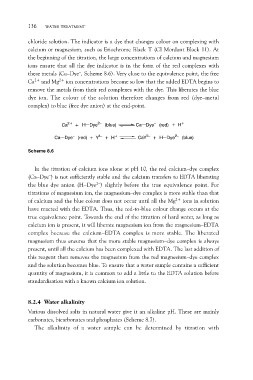
these metals (Ca–Dye–, Scheme 8.6). Very close to the equivalence point, the free
Ca2+ and Mg2+ ion concentrations become so low that the added EDTA begins to
remove the metals from their red complexes with the dye. This liberates the blue
dye ion. The colour of the solution therefore changes from red (dye–metal
complex) to blue (free dye anion) at the end-point.

                      Ca2+ + H Dye2– (blue)  Ca Dye– (red) + H+
                 Ca Dye– (red) + Y4– + H+     CaY2– + H Dye2– (blue)
Scheme 8.6

   In the titration of calcium ions alone at pH 10, the red calcium–dye complex
(Ca–Dye–) is not sufficiently stable and the calcium transfers to EDTA liberating
the blue dye anion (H–Dye2–) slightly before the true equivalence point. For
titrations of magnesium ion, the magnesium–dye complex is more stable than that
of calcium and the blue colour does not occur until all the Mg2+ ions in solution
have reacted with the EDTA. Thus, the red-to-blue colour change occurs at the
true equivalence point. Towards the end of the titration of hard water, as long as
calcium ion is present, it will liberate magnesium ion from the magnesium–EDTA
complex because the calcium–EDTA complex is more stable. The liberated
magnesium thus ensures that the more stable magnesium–dye complex is always
present, until all the calcium has been complexed with EDTA. The last addition of
this reagent then removes the magnesium from the red magnesium–dye complex
and the solution becomes blue. To ensure that a water sample contains a sufficient
quantity of magnesium, it is common to add a little to the EDTA solution before
standardisation with a known calcium ion solution.

8.2.4 Water alkalinity

Various dissolved salts in natural water give it an alkaline pH. These are mainly
carbonates, bicarbonates and phosphates (Scheme 8.7).

   The alkalinity of a water sample can be determined by titration with

