


Page 145 - Basic Principles of Textile Coloration
P. 145
134 WATER TREATMENT

of 1.5 mM. Since the molecular weight of CaCO3 is 100 g mol–1, 1.5 mM
corresponds to 150 mg l–1 of CaCO3, or 150 ppm (parts per million), assuming
that 1.0 l of the water has a mass of 1.0 kg. The permanent hardness is that
remaining after the water has been boiled and filtered to remove the precipitated
calcium and magnesium carbonates and magnesium hydroxide. The temporary
hardness is the difference between the total and permanent hardness.
Occasionally, hardness due to magnesium alone is of interest, again expressed as
the equivalent amount of CaCO3. For the water mentioned above, 0.5 mM of
magnesium ions is equivalent to 50 mg l–1 or 50 ppm CaCO3.

   Understanding water hardness values is often a tedious exercise in
manipulation of units. In the past, the hardness of water was given in units called
degrees. The definition of one degree of hardness, however, varied from one
country to the next (Table 8.2). It is much simpler to express hardness in mg l–1
or ppm of CaCO3.

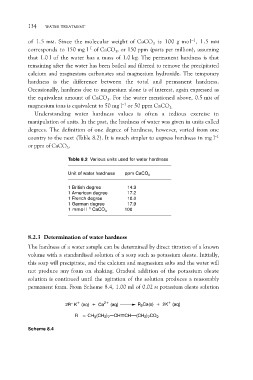
                          Table 8.2 Various units used for water hardness

            Unit of water hardness ppm CaCO3

            1 British degree          14.3
            1 American degree         17.2
            1 French degree           10.0
            1 German degree           17.9
            1 mmol l–1 CaCO3         100

8.2.3 Determination of water hardness

The hardness of a water sample can be determined by direct titration of a known
volume with a standardised solution of a soap such as potassium oleate. Initially,
this soap will precipitate, and the calcium and magnesium salts and the water will
not produce any foam on shaking. Gradual addition of the potassium oleate
solution is continued until the agitation of the solution produces a reasonably
permanent foam. From Scheme 8.4, 1.00 ml of 0.02 M potassium oleate solution

            2R– K+ (aq) + Ca2+ (aq)         R2Ca(s) + 2K+ (aq)

            R– = CH3(CH2)7 CH CH (CH2)7CO2–

Scheme 8.4

