


Page 143 - Basic Principles of Textile Coloration
P. 143
132 WATER TREATMENT

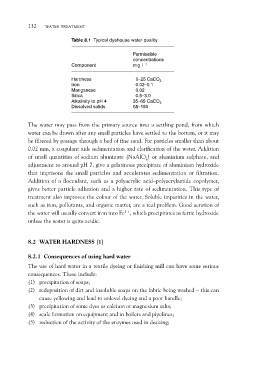
Table 8.1 Typical dyehouse water quality

Component            Permissible

                     concentrations
                     m g l–1

Hardness              0–25 CaCO3
Iron                  0.02–0.1
Manganese
Silica                0.02
Alkalinity to pH 4
Dissolved solids      0.5–3.0

                     35–65 CaCO3
                     65–150

The water may pass from the primary source into a settling pond, from which
water can be drawn after any small particles have settled to the bottom, or it may
be filtered by passage through a bed of fine sand. For particles smaller than about
0.02 mm, a coagulant aids sedimentation and clarification of the water. Addition
of small quantities of sodium aluminate (NaAlO2) or aluminium sulphate, and
adjustment to around pH 7, give a gelatinous precipitate of aluminium hydroxide
that imprisons the small particles and accelerates sedimentation or filtration.
Addition of a flocculant, such as a polyacrylic acid–polyacrylamide copolymer,
gives better particle adhesion and a higher rate of sedimentation. This type of
treatment also improves the colour of the water. Soluble impurities in the water,
such as iron, pollutants, and organic matter, are a real problem. Good aeration of
the water will usually convert iron into Fe3+, which precipitates as ferric hydroxide
unless the water is quite acidic.

8.2 WATER HARDNESS [1]

8.2.1 Consequences of using hard water
The use of hard water in a textile dyeing or finishing mill can have some serious
consequences. These include:
(1) precipitation of soaps;
(2) redeposition of dirt and insoluble soaps on the fabric being washed – this can

     cause yellowing and lead to unlevel dyeing and a poor handle;
(3) precipitation of some dyes as calcium or magnesium salts;
(4) scale formation on equipment and in boilers and pipelines;
(5) reduction of the activity of the enzymes used in desizing;

