


Page 148 - Basic Principles of Textile Coloration
P. 148
WATER HARDNESS 137
standardised sulphuric acid solution. With phenolphthalein as the indicator, the
equivalence point occurs at about pH 8.3. At this point, all free hydroxide ion is
neutralised, carbonate converted into bicarbonate, and phosphate (PO43–) into
monohydrogen phosphate (HPO42–). The alkalinity to pH 8.3 is calculated in ppm
CaCO3 based on Scheme 8.8. Therefore, each millimole of sulphuric acid required
corresponds to 1.00 mmol CaCO3 in the water sample. If the titration of a
100.0 ml water sample with 0.01 M sulphuric acid consumes V ml of acid, the
alkalinity is given by:
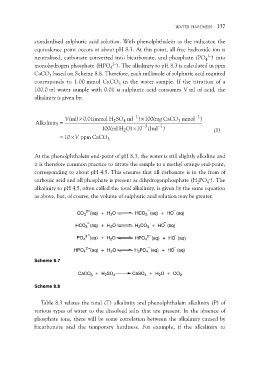
Alkalinity = V(ml) 0.01(mmol H2SO4 ml-1) 100(mg CaCO3 mmol-1)
100(ml H2O)10-3(l ml-1)
(1)
= 10 V ppm CaCO3
At the phenolphthalein end-point of pH 8.3, the water is still slightly alkaline and
it is therefore common practice to titrate the sample to a methyl orange end-point,
corresponding to about pH 4.5. This ensures that all carbonate is in the from of
carbonic acid and all phosphate is present as dihydrogenphosphate (H2PO4–). The
alkalinity to pH 4.5, often called the total alkalinity, is given by the same equation
as above, but, of course, the volume of sulphuric acid solution may be greater.
Scheme 8.7 CO32 (aq) + H2O HCO3 (aq) + HO (aq)
Scheme 8.8 HCO3 (aq) + H2O H2CO3 + HO (aq)
PO43 (aq) + H2O HPO42 (aq) + HO (aq)
HPO42 (aq) + H2O H2PO4 (aq) + HO (aq)
CaCO3 + H2SO4 CaSO4 + H2O + CO2
Table 8.3 relates the total (T) alkalinity and phenolphthalein alkalinity (P) of
various types of water to the dissolved salts that are present. In the absence of
phosphate ions, there will be some correlation between the alkalinity caused by
bicarbonate and the temporary hardness. For example, if the alkalinity to

