


Page 173 - Basic Principles of Textile Coloration
P. 173
162 AUXILIARY CHEMICALS FOR WET PROCESSING AND DYEING

using a surfactant is an appropriate starting point. As the two immiscible liquids
are vigorously stirred, the oil breaks up into small droplets dispersed in the water.
The oil–water interface has a high surface tension. The molecules in the bulk of
the hydrophobic oil pull in those at the surface in contact with the water. This
minimises the surface and the interaction with the surrounding water and the oil
droplets become spherical. If stirring is halted, the small oil drops will coalesce and
the liquids will separate into two layers, with the oil floating on top of the water. In
the presence of an anionic surfactant, such as sodium stearate, at its critical
micelle concentration, each tiny oil droplet becomes surrounded by surfactant
molecules, with their alkyl chains oriented into the oil surface and the anionic
‘heads’ extending into the water. The tiny droplet is like a giant micelle with an
oily centre. Once agitation stops, the tiny oil droplets cannot now coalesce as the
negatively charged monolayer of surfactant molecules at the oil–water interface
causes mutual repulsion of the drops. The oil remains emulsified. The droplets are
very small and they scatter light effectively, giving the emulsion a milky
appearance.

   The ability of surfactant molecules to adsorb on surfaces and orient themselves
so that the ionic group is in contact with the water, and the alkyl chain is oriented
away from it, is crucial in the wetting of fibres. This involves the spreading of
water all over their surfaces. There must be strong molecular interaction between
the water and the fibre to be wetted. This is aided by the accumulation and
orientation of surfactant molecules at the water–air and water–fibre interfaces.
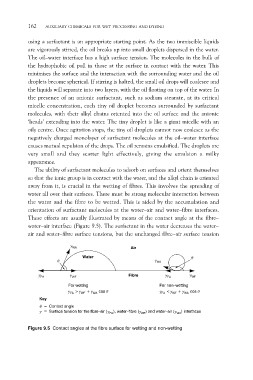
These effects are usually illustrated by means of the contact angle at the fibre–
water–air interface (Figure 9.5). The surfactant in the water decreases the water–
air and water–fibre surface tensions, but the unchanged fibre–air surface tension

                                       Air

     Water

     For wetting  cos                             Fibre            For non_wetting
          >+                           ), water_fibre (                 < + cos

Key                                                      ) and water_air ( ) interfaces

= Contact angle
= Surface tension for the fibre_air (

Figure 9.5 Contact angles at the fibre surface for wetting and non-wetting

