


Page 176 - Basic Principles of Textile Coloration
P. 176
SYNTHETIC SURFACTANTS 165

sulphonic acids (R–SO3Na, sulphonates), or of the sulphuric or phosphoric acid
esters of alcohols (R–O–SO3Na, sulphates; R–O–PO3Na, phosphates). They are
derived from both natural and synthetic chemicals.

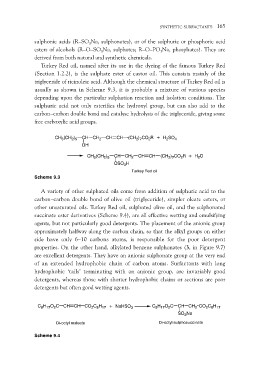
   Turkey Red oil, named after its use in the dyeing of the famous Turkey Red
(Section 1.2.2), is the sulphate ester of castor oil. This consists mainly of the
triglyceride of ricinoleic acid. Although the chemical structure of Turkey Red oil is
usually as shown in Scheme 9.3, it is probably a mixture of various species
depending upon the particular sulphation reaction and isolation conditions. The
sulphuric acid not only esterifies the hydroxyl group, but can also add to the
carbon–carbon double bond and catalyse hydrolysis of the triglyceride, giving some
free carboxylic acid groups.

CH3(CH2)5 CH CH2 CH CH (CH2)7CO2R + H2SO4
                 OH

            CH3(CH2)5  CH CH2 CH CH (CH2)7CO2R + H2O
                       OSO3H

                                    Turkey Red oil

Scheme 9.3

   A variety of other sulphated oils come from addition of sulphuric acid to the
carbon–carbon double bond of olive oil (triglyceride), simpler oleate esters, or
other unsaturated oils. Turkey Red oil, sulphated olive oil, and the sulphonated
succinate ester derivatives (Scheme 9.4), are all effective wetting and emulsifying
agents, but not particularly good detergents. The placement of the anionic group
approximately halfway along the carbon chain, so that the alkyl groups on either
side have only 6–10 carbons atoms, is responsible for the poor detergent
properties. On the other hand, alkylated benzene sulphonates (3, in Figure 9.7)
are excellent detergents. They have an anionic sulphonate group at the very end
of an extended hydrophobic chain of carbon atoms. Surfactants with long
hydrophobic ‘tails’ terminating with an anionic group, are invariably good
detergents, whereas those with shorter hydrophobic chains or sections are poor
detergents but often good wetting agents.

  C8H17O2C CH CH CO2C8H17 + NaHSO3  C8H17O2C CH CH2 CO2C8H17
                                                     SO3Na
                Di-octyl maleate
Scheme 9.4                               Di-octyl sulphosuccinate

