


Page 174 - Basic Principles of Textile Coloration
P. 174
SURFACE ACTIVITY OF DETERGENTS 163

causes extension of the droplet with a decrease in the contact angle. The water
drop therefore spreads out over the surface.

   Complete wetting of fibre surfaces is crucial in all wet processes for textiles,
particularly for dyeing. Uneven fibre wetting in dyeing invariably leads to uneven
dye absorption. Wetting agents are widely used in dyeing processes to ensure good
penetration of the dye liquor into the fibre mass. The chemicals used must be
compatible with the dyeing conditions and be effective wetting agents over a range
of temperatures, at various pH values and in the presence of salts.

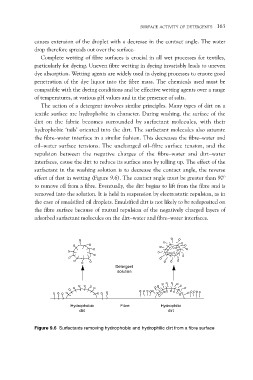
   The action of a detergent involves similar principles. Many types of dirt on a
textile surface are hydrophobic in character. During washing, the surface of the
dirt on the fabric becomes surrounded by surfactant molecules, with their
hydrophobic ‘tails’ oriented into the dirt. The surfactant molecules also saturate
the fibre–water interface in a similar fashion. This decreases the fibre–water and
oil–water surface tensions. The unchanged oil–fibre surface tension, and the
repulsion between the negative charges of the fibre–water and dirt–water
interfaces, cause the dirt to reduce its surface area by rolling up. The effect of the
surfactant in the washing solution is to decrease the contact angle, the reverse
effect of that in wetting (Figure 9.6). The contact angle must be greater than 90°
to remove oil from a fibre. Eventually, the dirt begins to lift from the fibre and is
removed into the solution. It is held in suspension by electrostatic repulsion, as in
the case of emulsified oil droplets. Emulsified dirt is not likely to be redeposited on
the fibre surface because of mutual repulsion of the negatively charged layers of
adsorbed surfactant molecules on the dirt–water and fibre–water interfaces.

             Detergent
              solution

Hydrophobic  Fibre      Hydrophilic
      dirt                   dirt

Figure 9.6 Surfactants removing hydrophobic and hydrophilic dirt from a fibre surface

