


Page 179 - Basic Principles of Textile Coloration
P. 179
168 AUXILIARY CHEMICALS FOR WET PROCESSING AND DYEING

The cationic product interacts with the anionic dye in the fibres, forming a high
molecular weight organic salt of decreased water solubility and much reduced
diffusion rate. The washing fastness is therefore improved. Unfortunately, many of
these products decrease the light fastness of the aftertreated dyeing.

9.3.3 Non-ionic surfactants
This is the second most important group of surfactants. They are mainly chemicals
whose molecules have the usual hydrophobic ‘tail’ connected to a short
polyethylene oxide chain. This will usually have about five to twenty –CH2CH2O–
units linked together and forms the polar hydrophilic ‘head’ to whose oxygen
atoms water molecules can hydrogen-bond. A wide range of products is available
with different types of hydrophobic groups and varying degrees of polymerisation
of the polyethylene oxide chain. Some have polypropylene oxide ‘heads’, usually
promoting oil solubility. The non-ionic surfactants are produced from natural or
synthetic carboxylic acids, alcohols, phenols, amines and amides, and ethylene
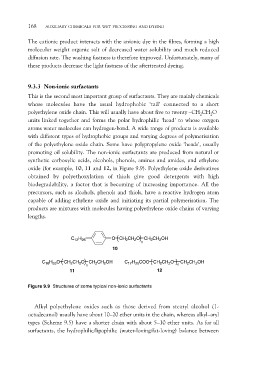
oxide (for example, 10, 11 and 12, in Figure 9.9). Polyethylene oxide derivatives
obtained by polyethoxylation of thiols give good detergents with high
biodegradability, a factor that is becoming of increasing importance. All the
precursors, such as alcohols, phenols and thiols, have a reactive hydrogen atom
capable of adding ethylene oxide and initiating its partial polymerisation. The
products are mixtures with molecules having polyethylene oxide chains of varying
lengths.

C12H25  O CH2CH2O n CH2CH2OH
        10

C16H33O CH2CH2O n CH2CH2OH  C17H35COO CH2CH2O n CH2CH2OH
                  11                             12

Figure 9.9 Structures of some typical non-ionic surfactants

   Alkyl polyethylene oxides such as those derived from stearyl alcohol (1-
octadecanol) usually have about 10–20 ether units in the chain, whereas alkyl–aryl
types (Scheme 9.5) have a shorter chain with about 5–10 ether units. As for all
surfactants, the hydrophilic/lipophilic (water-loving/fat-loving) balance between

