


Page 180 - Basic Principles of Textile Coloration
P. 180
SYNTHETIC SURFACTANTS 169

the polyethylene oxide ‘head’ and the hydrophobic ‘tail’ determines the
performance in a given application. Typically, about 65–70% of the molecular mass
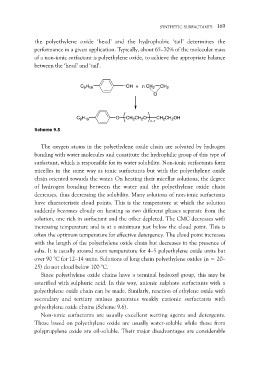
of a non-ionic surfactant is polyethylene oxide, to achieve the appropriate balance
between the ‘head’ and ‘tail’.

            C9H19  OH + n CH2 CH2
                                     O

            C9H19  O CH2CH2O n–1 CH2CH2OH

Scheme 9.5

   The oxygen atoms in the polyethylene oxide chain are solvated by hydrogen
bonding with water molecules and constitute the hydrophilic group of this type of
surfactant, which is responsible for its water solubility. Non-ionic surfactants form
micelles in the same way as ionic surfactants but with the polyethylene oxide
chain oriented towards the water. On heating their micellar solutions, the degree
of hydrogen bonding between the water and the polyethylene oxide chain
decreases, thus decreasing the solubility. Many solutions of non-ionic surfactants
have characteristic cloud points. This is the temperature at which the solution
suddenly becomes cloudy on heating as two different phases separate from the
solution, one rich in surfactant and the other depleted. The CMC decreases with
increasing temperature and is at a minimum just below the cloud point. This is
often the optimum temperature for effective detergency. The cloud point increases
with the length of the polyethylene oxide chain but decreases in the presence of
salts. It is usually around room temperature for 4–5 polyethylene oxide units but
over 90 °C for 12–14 units. Solutions of long chain polyethylene oxides (n = 20–
25) do not cloud below 100 °C.

   Since polyethylene oxide chains have a terminal hydroxyl group, this may be
esterified with sulphuric acid. In this way, anionic sulphate surfactants with a
polyethylene oxide chain can be made. Similarly, reaction of ethylene oxide with
secondary and tertiary amines generates weakly cationic surfactants with
polyethylene oxide chains (Scheme 9.6).

   Non-ionic surfactants are usually excellent wetting agents and detergents.
Those based on polyethylene oxide are usually water-soluble while those from
polypropylene oxide are oil-soluble. Their major disadvantages are considerable

