


Page 217 - Basic Principles of Textile Coloration
P. 217
206 DYEING THEORY

that the dye bonds to the fibre more strongly than it bonds to water in the external
aqueous solution. The enthalpy of dyeing in this case corresponds to the enthalpy
change for transfer of the dye from the aqueous solution into the fibre. It does not
include the enthalpy change associated with dissolution of the dye solid in the
water.

   The standard enthalpy of dyeing can be measured quite rapidly from the
concentrations of dye solutions in equilibrium with the same amount of dye in the
fibre at different temperatures. A given mass of dyed material is equilibrated with a
blank dyebath solution at a given temperature. The dilute solution of dye obtained
by desorption is then re-equilibrated with a second identical sample of the original
dyed material, so that almost no more dye is desorbed. The amount of dye in
solution is then determined by spectrophotometry. Thus, the dye in solution at
equilibrium at several temperatures is obtained for the same amount of dye on the
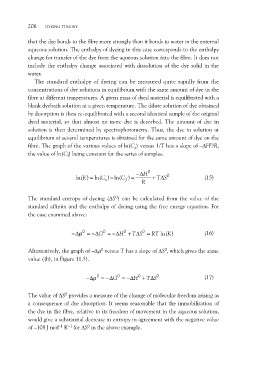
fibre. The graph of the various values of ln(Cs) versus 1/T has a slope of –DH0/R,
the value of ln(Cf) being constant for the series of samples.

ln(K) =  ln(Cs )- ln(Cf ) =  -DH0  + TDS0  (15)
                               R

The standard entropy of dyeing (DS0) can be calculated from the value of the
standard affinity and the enthalpy of dyeing using the free energy equation. For
the case examined above:

-Dm0 = -DG0 = -DH0 + TDS0 = RT ln(K)       (16)

Alternatively, the graph of –Dm0 versus T has a slope of DS0, which gives the same
value ((b), in Figure 11.5).

-Dm0 = -DG0 = -DH0 + TDS0                  (17)

The value of DS0 provides a measure of the change of molecular freedom arising as
a consequence of dye absorption. It seems reasonable that the immobilisation of
the dye in the fibre, relative to its freedom of movement in the aqueous solution,
would give a substantial decrease in entropy in agreement with the negative value
of –108 J mol–1 K–1 for DS0 in the above example.

