


Page 893 - Elementary_Linear_Algebra_with_Applications_Anton__9_edition
P. 893
11.6                            In this section we describe a general model of a system that changes from state
                                to state. We then apply the model to several concrete problems.
MARKOV CHAINS

                                                Prerequisites: Linear Systems

                                                                      Matrices

                                                                      Intuitive Understanding of Limits

A Markov Process

Suppose a physical or mathematical system undergoes a process of change such that at any moment it can occupy one of a finite
number of states. For example, the weather in a certain city could be in one of three possible states: sunny, cloudy, or rainy. Or an
individual could be in one of four possible emotional states: happy, sad, angry, or apprehensive. Suppose that such a system
changes with time from one state to another and at scheduled times the state of the system is observed. If the state of the system at
any observation cannot be predicted with certainty, but the probability that a given state occurs can be predicted by just knowing
the state of the system at the preceding observation, then the process of change is called a Markov chain or Markov process.

DEFINITION

If a Markov chain has k possible states, which we label as 1, 2, …, k, then the probability that the system is in state i at any

observation after it was in state j at the preceding observation is denoted by and is called the transition probability from

state j to state i. The matrix  is called the transition matrix of the Markov chain.

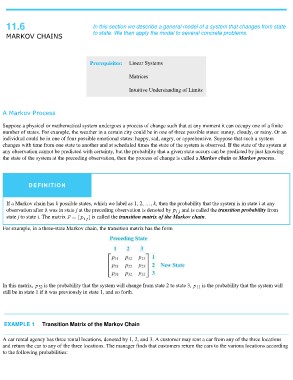
For example, in a three-state Markov chain, the transition matrix has the form

In this matrix, is the probability that the system will change from state 2 to state 3, is the probability that the system will
still be in state 1 if it was previously in state 1, and so forth.

EXAMPLE 1 Transition Matrix of the Markov Chain

A car rental agency has three rental locations, denoted by 1, 2, and 3. A customer may rent a car from any of the three locations
and return the car to any of the three locations. The manager finds that customers return the cars to the various locations according
to the following probabilities:

