


Page 79 - C:\Users\trainee\AppData\Local\Temp\msoEAA3.tmp
P. 79
Document Title
                 Fundamentals of Stress and Vibration                              2. Engineering Mechanics   Chapter
                 [A Practical guide for aspiring Designers / Analysts]


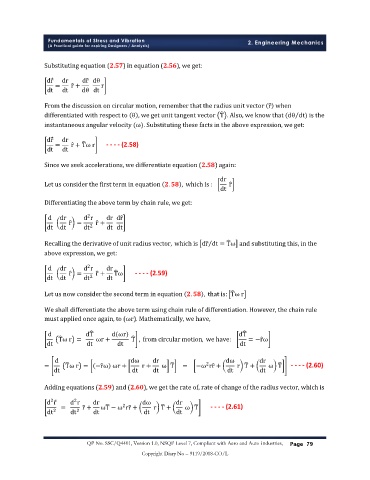
                  Substituting equation (2.57) in equation (2.56), we get:

                 dr   dr    dr  dθ
                   =     r  +      r
                 dt   dt    dθ dt

                From the discussion on circular motion, remember that the radius unit vector  r   when

                differentiated with respect to  θ , we get unit tangent vector  T . Also, we know that (dθ dt) is the

                instantaneous angular velocity (ω). Substituting these facts in the above expression, we get:
                 dr   dr

                   =     r  + Tω r    - - - - (2.58)
                 dt   dt
                Since we seek accelerations, we differentiate equation (2.58) again:

                                                                          dr
                Let us consider the first term in equation    .      ,  which is :        r
                                                                          dt

                Differentiating the above term by chain rule, we get:

                              2
                 d   dr      d r    dr dr
                         r   =   r  +
                 dt  dt      dt 2   dt dt

                Recalling the derivative of unit radius vector,  which is  dr  dt = Tω  and substituting this, in the

                above expression, we get:
                              2
                 d   dr      d r    dr
                                       Tω
                         r   =   r  +         - - - - (2.59)
                 dt  dt      dt 2   dt
                Let us now consider the second term in equation    .      ,  that is:  Tω r

                We shall differentiate the above term using chain rule of differentiation. However, the chain rule
                must applied once again, to (ωr). Mathematically, we have,


                 d           dT       d ωr                                      dT


                     Tω r  =     ωr +        T  ,  from circular motion,  we have:       = −r ω
                 dt           dt        dt                                      dt
                   d                        dω      dr                      dω         dr


                                                                     2
                =      Tω r  =   −r ω  ωr +      r +   ω  T     =     −ω rr  +     r  T +     ω  T    - - - - (2.60)
                   dt                        dt     dt                      dt         dt
                Adding equations (2.59) and (2.60), we get the rate of, rate of change of the radius vector, which is:
                  2
                          2
                 d r    d r     dr              dω         dr


                                          2
                      =      r  +  ωT − ω rr  +     r  T +     ω  T    - - - - (2.61)
                 dt 2   dt 2    dt               dt        dt

                              QP No. SSC/Q4401, Version 1.0, NSQF Level 7, Compliant with Aero and Auto Industries,   P
                                                                                                 Page 79 age 79
                                                Copyright Diary No – 9119/2018-CO/L

