


Page 78 - C:\Users\trainee\AppData\Local\Temp\msoEAA3.tmp
P. 78
Document Title
                Fundamentals of Stress and Vibration                                  Chapter Title
                [A Practical guide for aspiring Designers / Analysts]              2. Engineering Mechanics


                However, a fourth acceleration is produced due the radial and angular velocities. This acceleration is
                called the “Coriolis” acceleration. The Coriolis acceleration is responsible for several natural and
                mechanical phenomena. Example, cyclones, missiles missing the target, ocean currents, turbulence
                in flows, mechanisms (quick return motion mechanism) etc.

                Therefore, finding the acceleration becomes a challenge, these accelerations could be:

                    ü  Radial acceleration  d r dt   due to change of radius with respect to time.
                                            2
                                                 2

                    ü  Tangential acceleration due to rate of change of angular velocity  dω dt .

                                                    2
                    ü  The centripetal acceleration (V   r) is variable, as both the radii and velocity change from
                       point to point.
                    ü  Since there is a rate of change of radius and the radius itself is rotating (as there is angular
                       motion), the Coriolis  2Vω  component comes into play.


                Let us now derive the four accelerations for curvilinear motion.


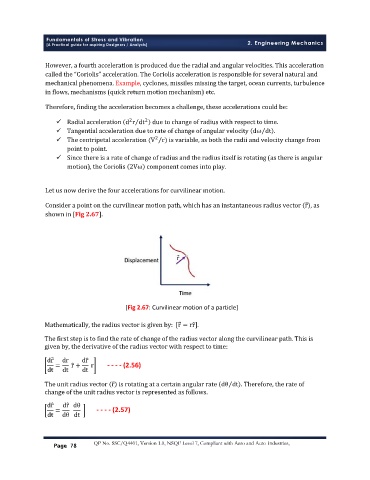
                Consider a point on the curvilinear motion path, which has an instantaneous radius vector  r  , as
                shown in [Fig 2.67].


                                           [Fig 2.67: Curvilinear motion of a particle]


                Mathematically, the radius vector is given by:   r  = rr  .

                The first step is to find the rate of change of the radius vector along the curvilinear path. This is
                given by, the derivative of the radius vector with respect to time:

                 dr   dr    dr
                   =     r  +   r    - - - - (2.56)
                 dt   dt    dt
                The unit radius vector  r   is rotating at a certain angular rate  dθ dt . Therefore, the rate of

                change of the unit radius vector is represented as follows.

                 dr   dr  dθ
                   =             - - - - (2.57)
                 dt   dθ dt


                   Page 78      QP No. SSC/Q4401, Version 1.0, NSQF Level 7, Compliant with Aero and Auto Industries,

