Page 76 - C:\Users\trainee\AppData\Local\Temp\msoEAA3.tmp
P. 76
Document Title
                Fundamentals of Stress and Vibration                                  Chapter Title
                [A Practical guide for aspiring Designers / Analysts]              2. Engineering Mechanics


                 šƒ’Ž‡ ͵ǣ ’”‘˜‡ –Šƒ–ǡ –Ї –‹‡ ‘ˆ ”‘ŽŽ‹‰ ‹• ‘– ‹†‡’‡†‡– ‘ˆ –Ї ƒ••Ǥ

                 ‘Ž—–‹‘ǣ ˆ‘” ƒ Š‘‘‰‡‘—• …›Ž‹†‡”ǡ ‹– ‹• –”—‡ –Šƒ–ǡ –Ї –‹‡ ‘ˆ ”‘ŽŽ‹‰ ‹• ‹†‡’‡†‡– ‘ˆ ƒ••Ǥ
                 ‘™‡˜‡”ǡ ˆ‘” …‘’‘•‹–‡ ‘„Œ‡…–•ǡ –‹‡ ‘ˆ ”‘ŽŽ‹‰ ‹• †‡’‡†‡– ‘ †‡•‹–› ”ƒ–‹‘ ‘ˆ –Ї …‘’‘‡–• ‘ˆ
                –Ї …‘’‘•‹–‡ ‘„Œ‡…–Ǥ
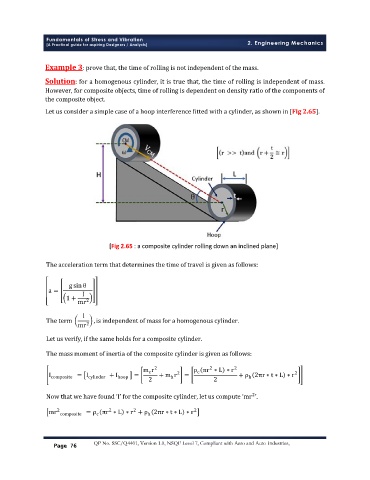
                 ‡– —• …‘•‹†‡” ƒ •‹’އ …ƒ•‡ ‘ˆ ƒ Š‘‘’ ‹–‡”ˆ‡”‡…‡ ϐ‹––‡† ™‹–Š ƒ …›Ž‹†‡”ǡ ƒ• •Š‘™ ‹ ȏ ‹‰ ʹǤ͸ͷȐǤ


                                     [Fig 2.65 : a composite cylinder rolling down an inclined plane]


                The acceleration term that determines the time of travel is given as follows:


                        g sin θ
                  a =
                       1 +  I
                           mr 2
                            I
                The term        , is independent of mass for a homogenous cylinder.
                           mr 2
                Let us verify, if the same holds for a composite cylinder.

                The mass moment of inertia of the composite cylinder is given as follows:


                                                                      2
                                                m r 2            ρ  πr ∗ L  ∗ r 2
                                                  c
                                                                  c
                                                                                                   2
                                                            2
                 I composite  =  I cylinder  + I hoop    =    + m r   =         + ρ  2πr ∗ t ∗ L  ∗ r
                                                                                   h
                                                          h
                                                  2                     2
                Now that we have found ‘I’ for the composite cylinder, let us compute ‘mr ’.
                                                                                    2
                                                                 2
                                     2
                                             2
                 mr 2 composite  = ρ  πr ∗ L  ∗ r + ρ  2πr ∗ t ∗ L  ∗ r
                                 c
                                                  h

                   Page 76      QP No. SSC/Q4401, Version 1.0, NSQF Level 7, Compliant with Aero and Auto Industries,
   71   72   73   74   75   76   77   78   79   80   81