


Page 159 - Fisika Terapan for Engineers and Scientists
P. 159
Problems                              359


                         besieged city and the enemy camp, he jumped on a cannonball  *45. Two automobiles of 540 and 1400 kg collide head-on while
                         as it was being fired from the city, rode the cannonball toward  moving at 80 km h in opposite directions. After the collision
                         the enemy camp, and then, in midair, jumped onto an enemy  the automobiles remain locked together.
                         cannonball and rode back to the city. The collision of Münch-  (a) Find the velocity of the wreck immediately after the collision.
                         hausen and the enemy cannonball must have been inelastic,
                                                                              (b) Find the kinetic energy of the two-automobile system
                         since he held on to it. Suppose that his speed just before hit-
                                                                                 before and after the collision.
                         ting the enemy cannonball was 150 m s southward and the
                         speed of the enemy cannonball was 300 m s northward. The  (c) The front end of each automobile crumples by 0.60 m
                         mass of Münchhausen was 90 kg, and the mass of the enemy  during the collision. Find the acceleration (relative to the
                         cannonball was 20 kg. What must have been the speed just  ground) of the passenger compartment of each automobile;
                         after the collision? Do you think he made it back to the city?  make the assumption that these accelerations are constant
                                                                                 during the collision.
                      39. As described in Problem 6, the change of velocity  v of an
                         automobile during a collision is a measure of the severity of  *46. A speeding automobile strikes the rear of a parked automobile.
                         the collision. Suppose that an automobile moving with an ini-  After the impact the two automobiles remain locked together,
                         tial speed of 15 m s collides with (a) an automobile of equal  and they skid along the pavement with all their wheels locked.
                         mass initially at rest, (b) an automobile of equal mass initially  An investigation of this accident establishes that the length of
                         moving in the opposite direction at 15 m s, or (c) a stationary  the skid marks made by the automobiles after the impact was
                         rigid barrier. Assume that the collision is totally inelastic.  18 m; the mass of the moving automobile was 2200 kg and that
                         What is  v in each case?                             of the parked automobile was 1400 kg, and the coefficient of
                                                                              sliding friction between the wheels and the pavement was 0.95.
                      40. A 25-kg boy on a 10-kg sled is coasting at 3.0 m s on level ice
                         toward his 30-kg sister. The girl jumps vertically and lands on  (a) What was the speed of the two automobiles immediately
                         her brother’s back. What is the final speed of the siblings and  after impact?
                         sled?  Neglect friction.                             (b) What was the speed of the moving automobiles before
                      41. A 75-kg woman and a 65-kg man face each other on a friction-  impact?
                         less ice pond. The woman holds a 5.0-kg “medicine ball.” The  *47. A proton of energy 8.0   10  13  J collides head-on with a
                         woman throws the ball to the man with a horizontal velocity  proton at rest. How much energy is available for inelastic reac-
                         of 2.5 m s relative to the ice. What is her recoil velocity? What  tions between these protons?
                         is the man’s velocity after catching the ball? The man then  *48. According to test procedures laid down by the National
                         throws the ball horizontally to the woman at 3.0 m s relative  Highway Traffic Safety Administration, a stationary barrier
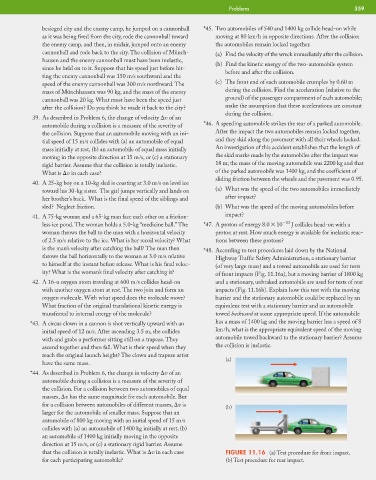
                         to himself at the instant before release. What is his final veloc-  (of very large mass) and a towed automobile are used for tests
                         ity? What is the woman’s final velocity after catching it?  of front impacts (Fig. 11.16a), but a moving barrier of 1800 kg
                      42. A 16-u oxygen atom traveling at 600 m s collides head-on  and a stationary, unbraked automobile are used for tests of rear
                         with another oxygen atom at rest. The two join and form an  impacts (Fig. 11.16b). Explain how this test with the moving
                         oxygen molecule. With what speed does the molecule move?  barrier and the stationary automobile could be replaced by an
                         What fraction of the original translational kinetic energy is  equivalent test with a stationary barrier and an automobile
                         transferred to internal energy of the molecule?      towed backward at some appropriate speed. If the automobile
                      *43. A circus clown in a cannon is shot vertically upward with an  has a mass of 1400 kg and the moving barrier has a speed of 8
                         initial speed of 12 m s. After ascending 3.5 m, she collides  km h, what is the appropriate equivalent speed of the moving
                         with and grabs a performer sitting still on a trapeze. They  automobile towed backward to the stationary barrier? Assume
                         ascend together and then fall. What is their speed when they  the collision is inelastic.
                         reach the original launch height? The clown and trapeze artist
                                                                                 (a)
                         have the same mass.
                      *44. As described in Problem 6, the change in velocity  v of an
                         automobile during a collision is a measure of the severity of
                         the collision. For a collision between two automobiles of equal
                         masses,  v has the same magnitude for each automobile. But
                         for a collision between automobiles of different masses,  v is  (b)
                         larger for the automobile of smaller mass. Suppose that an
                         automobile of 800 kg moving with an initial speed of 15 m s
                         collides with (a) an automobile of 1400 kg initially at rest, (b)
                         an automobile of 1400 kg initially moving in the opposite
                         direction at 15 m s, or (c) a stationary rigid barrier. Assume
                         that the collision is totally inelastic. What is  v in each case  FIGURE 11.16 (a) Test procedure for front impact.
                         for each participating automobile?                      (b) Test procedure for rear impact.

