


Page 160 - Fisika Terapan for Engineers and Scientists
P. 160
360                                CHAPTER 11  Collisions


                 *49. Regard the two automobiles described in Example 7 as a  of mass 15 g fired into a block of 4.0 kg sitting on a 1.8-m
                    system of two particles.                             fence causes the block to land 1.4 m from the bottom of the
                                                                         fence. Calculate the speed of the bullet.
                    (a) What is the translational kinetic energy of the center of
                       mass before the collision? After the collision?
                    (b) What is the total kinetic energy before the collision? After  11.4 Collisions in Two and
                       the collision?                                Three Dimensions
                 *50. A cat crouches on the floor, at a distance of 1.2 m from a desk
                    chair of height 0.45 m. The cat jumps onto the chair, landing  56. A cheetah intercepts a gazelle on the run, and grabs it (a totally
                    with zero vertical velocity (this is standard procedure for cat  inelastic collision). Just before this collision, the gazelle was
                    jumps). The desk chair has frictionless coasters and rolls away  running due north at 20 m s, and the cheetah was running on
                    when the cat lands. The mass of the cat is 4.5 kg, and the mass  an intercepting course of 45  east of north at 22 m s.The mass
                    of the chair is 12 kg. What is the speed of recoil of the chair  of the cheetah is 60 kg, and the mass of the gazelle is 50 kg.
                    and cat?                                             What are the magnitude and the direction of the velocity of
                                                                         the entangled animals at the instant after the collision?
                 *51. A crude but simple method for measuring the speed of a
                    bullet is to shoot the bullet horizontally into a block of wood  57. Two hydrogen atoms (m   1.0 u) with equal speeds, initially
                    resting on a table. The block of wood will then slide until its  traveling in perpendicular directions, collide and join together
                                                                                                       22
                    kinetic energy is expended against the friction of the surface  to form a hydrogen molecule. If 6.1   10  J of the initial
                    of the table. Suppose that a 3.0-kg block of wood slides a  kinetic energy is transferred to internal energy in the collision,
                    distance of 6.0 cm after it is struck by a bullet of 12 g. If the  what was the initial speed of the atoms?
                    coefficient of sliding friction for the wood on the table is  *58. Two automobiles of equal masses collide at an intersection.
                    0.60, what impact speed can you deduce for the bullet?  One was traveling eastward and the other northward. After
                 *52. Another way (not recommended) to measure the speed of  the collision, they remain joined together and skid, with
                    bullets with a ballistic pendulum is to shoot a steady stream of  locked wheels, before coming to rest. The length of the skid
                    bullets into the pendulum, which will push it aside and hold  marks is 18 m, and the coefficient of friction between the
                    it in a rough equilibrium position at some angle. The speed  locked wheels and the pavement is 0.80. Each driver claims
                    can be calculated from this equilibrium angle. Suppose that  his speed was less than 14 m s (50 km h) before the collision.
                    you shoot .22-caliber bullets of mass 15 g into a 4.0-kg ballis-  Prove that at least one driver is lying.
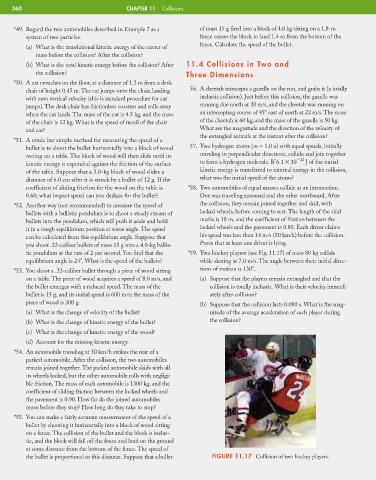
                    tic pendulum at the rate of 2 per second. You find that the  *59. Two hockey players (see Fig. 11.17) of mass 80 kg collide
                    equilibrium angle is 24 . What is the speed of the bullets?  while skating at 7.0 m s. The angle between their initial direc-
                 *53. You shoot a .22-caliber bullet through a piece of wood sitting  tions of motion is 130 .
                    on a table. The piece of wood acquires a speed of 8.0 m s, and  (a) Suppose that the players remain entangled and that the
                    the bullet emerges with a reduced speed. The mass of the  collision is totally inelastic. What is their velocity immedi-
                    bullet is 15 g, and its initial speed is 600 m s; the mass of the  ately after collision?
                    piece of wood is 300 g.                              (b) Suppose that the collision lasts 0.080 s. What is the mag-
                    (a) What is the change of velocity of the bullet?       nitude of the average acceleration of each player during
                    (b) What is the change of kinetic energy of the bullet?  the collision?
                    (c) What is the change of kinetic energy of the wood?
                    (d) Account for the missing kinetic energy.
                 *54. An automobile traveling at 50 km h strikes the rear of a
                    parked automobile. After the collision, the two automobiles
                    remain joined together. The parked automobile skids with all
                    its wheels locked, but the other automobile rolls with negligi-
                    ble friction. The mass of each automobile is 1300 kg, and the
                    coefficient of sliding friction between the locked wheels and
                    the pavement is 0.90. How far do the joined automobiles
                    move before they stop? How long do they take to stop?
                 *55. You can make a fairly accurate measurement of the speed of a
                    bullet by shooting it horizontally into a block of wood sitting
                    on a fence. The collision of the bullet and the block is inelas-
                    tic, and the block will fall off the fence and land on the ground
                    at some distance from the bottom of the fence. The speed of
                    the bullet is proportional to this distance. Suppose that a bullet  FIGURE 11.17 Collision of two hockey players.

