


Page 158 - Fisika Terapan for Engineers and Scientists
P. 158
358                                CHAPTER 11  Collisions


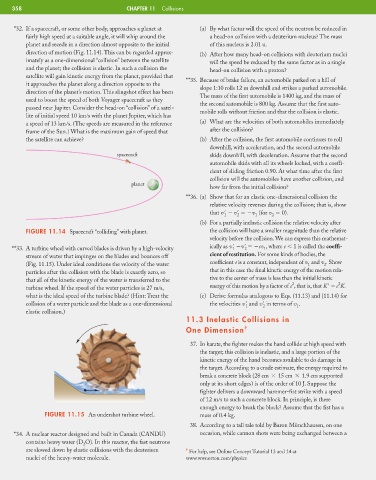
                 *32. If a spacecraft, or some other body, approaches a planet at  (a) By what factor will the speed of the neutron be reduced in
                    fairly high speed at a suitable angle, it will whip around the  a head-on collision with a deuterium nucleus? The mass
                    planet and recede in a direction almost opposite to the initial  of this nucleus is 2.01 u.
                    direction of motion (Fig. 11.14). This can be regarded approx-  (b) After how many head-on collisions with deuterium nuclei
                    imately as a one-dimensional “collision” between the satellite  will the speed be reduced by the same factor as in a single
                    and the planet; the collision is elastic. In such a collision the  head-on collision with a proton?
                    satellite will gain kinetic energy from the planet, provided that
                                                                     **35. Because of brake failure, an automobile parked on a hill of
                    it approaches the planet along a direction opposite to the
                                                                         slope 1:10 rolls 12 m downhill and strikes a parked automobile.
                    direction of the planet’s motion. This slingshot effect has been
                                                                         The mass of the first automobile is 1400 kg, and the mass of
                    used to boost the speed of both Voyager spacecraft as they
                                                                         the second automobile is 800 kg. Assume that the first auto-
                    passed near Jupiter. Consider the head-on “collision” of a satel-
                                                                         mobile rolls without friction and that the collision is elastic.
                    lite of initial speed 10 km s with the planet Jupiter, which has
                    a speed of 13 km s. (The speeds are measured in the reference  (a) What are the velocities of both automobiles immediately
                    frame of the Sun.) What is the maximum gain of speed that  after the collision?
                    the satellite can achieve?                           (b) After the collision, the first automobile continues to roll
                                                                            downhill, with acceleration, and the second automobile
                                                spacecraft                  skids downhill, with deceleration. Assume that the second
                                                                            automobile skids with all its wheels locked, with a coeffi-
                                                                            cient of sliding friction 0.90. At what time after the first
                                                                            collision will the automobiles have another collision, and
                                                    planet
                                                                            how far from the initial collision?
                                                                     **36. (a) Show that for an elastic one-dimensional collision the
                                                                            relative velocity reverses during the collision; that is, show
                                                                            that v    v    v (for v   0).
                                                                                    2
                                                                                1
                                                                                               2
                                                                                          1
                                                                         (b) For a partially inelastic collision the relative velocity after
                    FIGURE 11.14 Spacecraft “colliding” with planet.        the collision will have a smaller magnitude than the relative
                                                                            velocity before the collision. We can express this mathemat-
                **33. A turbine wheel with curved blades is driven by a high-velocity  ically as v   v     ev , where e
 1 is called the coeffi-
                                                                                   1
                                                                                            1
                                                                                       2
                    stream of water that impinges on the blades and bounces off  cient of restitution. For some kinds of bodies, the
                    (Fig. 11.15). Under ideal conditions the velocity of the water  coefficient e is a constant, independent of v and v .Show
                                                                                                               2
                                                                                                          1
                    particles after the collision with the blade is exactly zero, so  that in this case the final kinetic energy of the motion rela-
                    that all of the kinetic energy of the water is transferred to the  tive to the center of mass is less than the initial kinetic  2
                                                                                                     2
                    turbine wheel. If the speed of the water particles is 27 m s,  energy of this motion by a factor of e , that is, that K   e K.
                    what is the ideal speed of the turbine blade? (Hint: Treat the  (c) Derive formulas analogous to Eqs. (11.13) and (11.14) for
                    collision of a water particle and the blade as a one-dimensional  the velocities v  and v  in terms of v .
                                                                                                      1
                                                                                            2
                                                                                       1
                    elastic collision.)
                                                                     11.3 Inelastic Collisions in
                                                                     One Dimension     †
                                                                      37. In karate, the fighter makes the hand collide at high speed with
                                                                         the target; this collision is inelastic, and a large portion of the
                                                                         kinetic energy of the hand becomes available to do damage in
                                                                         the target. According to a crude estimate, the energy required to
                                                                         break a concrete block (28 cm   15 cm   1.9 cm supported
                                                                         only at its short edges) is of the order of 10 J. Suppose the
                                                                         fighter delivers a downward hammer-fist strike with a speed
                                                                         of 12 m s to such a concrete block. In principle, is there
                                                                         enough energy to break the block? Assume that the fist has a
                          FIGURE 11.15 An undershot turbine wheel.       mass of 0.4 kg.
                                                                      38. According to a tall tale told by Baron Münchhausen, on one
                 *34. A nuclear reactor designed and built in Canada (CANDU)  occasion, while cannon shots were being exchanged between a
                    contains heavy water (D O). In this reactor, the fast neutrons
                                      2
                    are slowed down by elastic collisions with the deuterium  †  For help, see Online Concept Tutorial 13 and 14 at
                    nuclei of the heavy-water molecule.              www.wwnorton.com/physics

