


Page 238 - Fisika Terapan for Engineers and Scientists
P. 238
438                                CHAPTER 14  Statics and Elasticity


                                                                  (a)                 (b)
                                                                                       y
                                                                                         Frictionless wall can exert
                                                                                         only a normal force.

                                                                                              N 2
                                                                                           a
                                                                                                 Weight acts at
                                                                                                 center of mass.
                                                                                        u
                                                                       u                          Floor exerts both
                                                                            l                     a normal force and
                                                                                                  a friction force.
                                                                                                   N 1
                                                                                             w


                                                                                      0                    x
                                                                                                f
                                                                                            Ladder is about to slip
                                                         FIGURE 14.9 (a) Ladder leaning against a  when f = m s  N .
                                                                                                     1
                                                         wall. (b) “Free-body” diagram for the ladder.


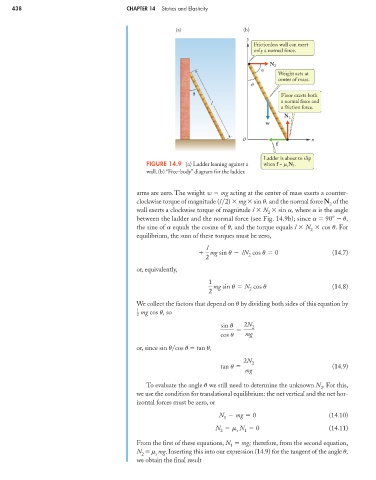
                                                      arms are zero. The weight w   mg acting at the center of mass exerts a counter-
                                                      clockwise torque of magnitude (l 2)   mg   sin  , and the normal force N of the
                                                                                                                2
                                                      wall exerts a clockwise torque of magnitude l   N   sin  , where   is the angle
                                                                                              2
                                                      between the ladder and the normal force (see Fig. 14.9b); since     90    ,
                                                      the sine of   equals the cosine of  , and the torque equals l   N   cos  .For
                                                                                                           2
                                                      equilibrium, the sum of these torques must be zero,
                                                                           l
                                                                           mg sin u    lN  cos u   0             (14.7)
                                                                                        2
                                                                           2
                                                      or, equivalently,
                                                                            1
                                                                             mg sin u   N  cos u                 (14.8)
                                                                                        2
                                                                            2
                                                      We collect the factors that depend on   by dividing both sides of this equation by
                                                      1
                                                      2  mg cos  , so
                                                                               sin u  2N 2

                                                                               cos u   mg
                                                      or, since sin   cos     tan  ,
                                                                                      2N 2
                                                                               tan u                             (14.9)
                                                                                       mg

                                                         To evaluate the angle   we still need to determine the unknown N . For this,
                                                                                                              2
                                                      we use the condition for translational equilibrium: the net vertical and the net hor-
                                                      izontal forces must be zero, or

                                                                               N   mg   0                       (14.10)
                                                                                1
                                                                                N   m  N   0                    (14.11)
                                                                               2    s  1
                                                      From the first of these equations, N   mg; therefore, from the second equation,
                                                                                  1
                                                      N     mg. Inserting this into our expression (14.9) for the tangent of the angle  ,
                                                       2    s
                                                      we obtain the final result

