


Page 241 - Fisika Terapan for Engineers and Scientists
P. 241
14.3  Levers and Pulleys                         441


                     zero net torque. If a fish starts to pull downward on the far end of the pole, then to
                     maintain equilibrium you must
                        (A) Increase the upward push and decrease the downward push
                        (B) Increase the upward push and increase the downward push
                        (C) Increase the upward push and keep the downward push the same
                                                                                                   Equilibrium forces are in
                                                                                                   inverse ratio to distance
                                                                                                   from fulcrum.
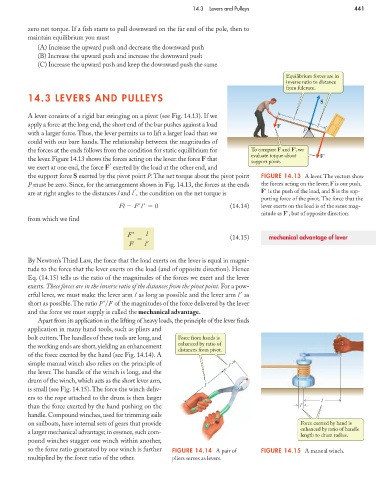
                     14.3 LEVERS AND PULLEYS                                                                  S


                     A lever consists of a rigid bar swinging on a pivot (see Fig. 14.13). If we
                                                                                                     l
                     apply a force at the long end, the short end of the bar pushes against a load  F        l'
                     with a larger force. Thus, the lever permits us to lift a larger load than we      P
                     could with our bare hands. The relationship between the magnitudes of
                     the forces at the ends follows from the condition for static equilibrium for  To compare F and F', we
                                                                                         evaluate torque about  F'
                     the lever. Figure 14.13 shows the forces acting on the lever: the force F that  support point.

                     we exert at one end, the force F exerted by the load at the other end, and
                     the support force S exerted by the pivot point P.The net torque about the pivot point  FIGURE 14.13 A lever. The vectors show
                     P must be zero. Since, for the arrangement shown in Fig. 14.13, the forces at the ends  the forces acting on the lever; F is our push,

                     are at right angles to the distances l and l , the condition on the net torque is  F  is the push of the load, and S is the sup-
                                                                                            porting force of the pivot. The force that the
                                                Fl   F  l    0                    (14.14)   lever exerts on the load is of the same mag-
                                                                                            nitude as F , but of opposite direction.
                     from which we find

                                                   F     l
                                                                                  (14.15)     mechanical advantage of lever
                                                   F    l

                     By Newton’s Third Law, the force that the load exerts on the lever is equal in magni-
                     tude to the force that the lever exerts on the load (and of opposite direction). Hence
                     Eq. (14.15) tells us the ratio of the magnitudes of the forces we exert and the lever
                     exerts. These forces are in the inverse ratio of the distances from the pivot point. For a pow-
                     erful lever, we must make the lever arm l as long as possible and the lever arm l  as
                     short as possible.The ratio F  F of the magnitudes of the force delivered by the lever
                     and the force we must supply is called the mechanical advantage.
                        Apart from its application in the lifting of heavy loads, the principle of the lever finds
                     application in many hand tools, such as pliers and
                     bolt cutters.The handles of these tools are long, and  Force from hands is
                     the working ends are short, yielding an enhancement  enhanced by ratio of
                                                                  distances from pivot.
                     of the force exerted by the hand (see Fig. 14.14). A
                     simple manual winch also relies on the principle of          l'
                     the lever. The handle of the winch is long, and the
                     drum of the winch, which acts as the short lever arm,
                                                                          l
                     is small (see Fig. 14.15).The force the winch deliv-
                     ers to the rope attached to the drum is then larger
                                                                                                              l
                     than the force exerted by the hand pushing on the                                 l'
                     handle. Compound winches, used for trimming sails
                     on sailboats, have internal sets of gears that provide                             Force exerted by hand is
                                                                                                        enhanced by ratio of handle
                     a larger mechanical advantage; in essence, such com-
                                                                                                        length to drum radius.
                     pound winches stagger one winch within another,
                     so the force ratio generated by one winch is further  FIGURE 14.14 A pair of  FIGURE 14.15 A manual winch.
                     multiplied by the force ratio of the other.  pliers serves as levers.

