


Page 240 - Fisika Terapan for Engineers and Scientists
P. 240
440                                CHAPTER 14  Statics and Elasticity


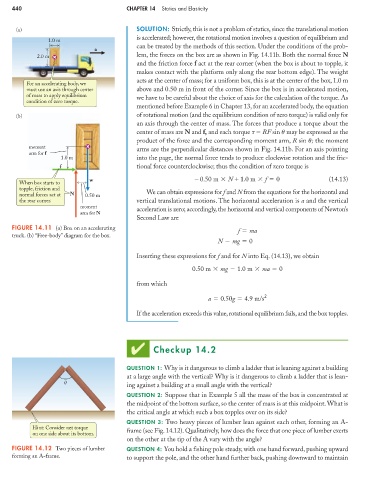
                 (a)                                  SOLUTION: Strictly, this is not a problem of statics, since the translational motion
                                                      is accelerated; however, the rotational motion involves a question of equilibrium and
                           1.0 m
                                         a            can be treated by the methods of this section. Under the conditions of the prob-
                        2.0 m                         lem, the forces on the box are as shown in Fig. 14.11b. Both the normal force N
                                                      and the friction force f act at the rear corner (when the box is about to topple, it
                                                      makes contact with the platform only along the rear bottom edge). The weight
                                                      acts at the center of mass; for a uniform box, this is at the center of the box, 1.0 m
                    For an accelerating body, we
                    must use an axis through center   above and 0.50 m in front of the corner. Since the box is in accelerated motion,
                    of mass to apply equilibrium      we have to be careful about the choice of axis for the calculation of the torque. As
                    condition of zero torque.
                                                      mentioned before Example 6 in Chapter 13, for an accelerated body, the equation
                 (b)                                  of rotational motion (and the equilibrium condition of zero torque) is valid only for
                                                      an axis through the center of mass. The forces that produce a torque about the
                                                      center of mass are N and f, and each torque     RF sin   may be expressed as the
                                                      product of the force and the corresponding moment arm, R sin  ; the moment
                     moment                           arms are the perpendicular distances shown in Fig. 14.11b. For an axis pointing
                     arm for f
                               1.0 m                  into the page, the normal force tends to produce clockwise rotation and the fric-
                              f                       tional force counterclockwise; thus the condition of zero torque is

                                        w                               0.50 m   N   1.0 m   f   0              (14.13)
                  When box starts to
                  topple, friction and
                  normal forces act at  N  0.50 m        We can obtain expressions for f and N from the equations for the horizontal and
                  the rear corner.                    vertical translational motions. The horizontal acceleration is a and the vertical
                                     moment           acceleration is zero; accordingly, the horizontal and vertical components of Newton’s
                                     arm for N
                                                      Second Law are
                FIGURE 14.11 (a) Box on an accelerating
                                                                                       f   ma
                truck. (b) “Free-body” diagram for the box.
                                                                              N   mg   0
                                                      Inserting these expressions for f and for N into Eq. (14.13), we obtain

                                                                       0.50 m   mg   1.0 m   ma   0

                                                      from which

                                                                            a   0.50g   4.9 m/s 2
                                                      If the acceleration exceeds this value,rotational equilibrium fails,and the box topples.


                                                    ✔      Checkup 14.2


                                                   QUESTION 1: Why is it dangerous to climb a ladder that is leaning against a building
                                                   at a large angle with the vertical? Why is it dangerous to climb a ladder that is lean-

                                                   ing against a building at a small angle with the vertical?
                                                   QUESTION 2: Suppose that in Example 5 all the mass of the box is concentrated at
                                                   the midpoint of the bottom surface, so the center of mass is at this midpoint. What is
                                                   the critical angle at which such a box topples over on its side?
                                                   QUESTION 3: Two heavy pieces of lumber lean against each other, forming an A-
                      Hint: Consider net torque
                      on one side about its bottom.  frame (see Fig. 14.12). Qualitatively, how does the force that one piece of lumber exerts
                                                   on the other at the tip of the A vary with the angle?
                FIGURE 14.12 Two pieces of lumber  QUESTION 4: You hold a fishing pole steady, with one hand forward, pushing upward
                forming an A-frame.                to support the pole, and the other hand further back, pushing downward to maintain

