


Page 242 - Fisika Terapan for Engineers and Scientists
P. 242
442                                CHAPTER 14  Statics and Elasticity


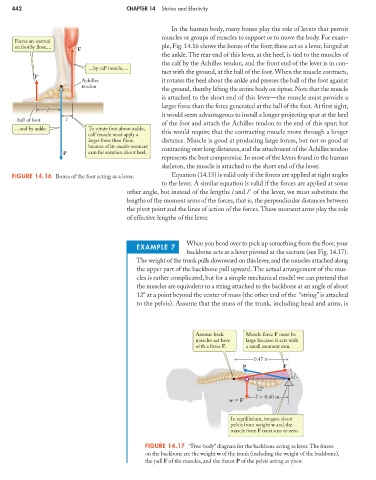
                                                                In the human body, many bones play the role of levers that permit
                                                             muscles or groups of muscles to support or to move the body. For exam-
                 Forces are exerted
                 on foot by floor,…                          ple, Fig. 14.16 shows the bones of the foot; these act as a lever, hinged at
                                    F
                                                             the ankle.The rear end of this lever, at the heel, is tied to the muscles of
                                                             the calf by the Achilles tendon, and the front end of the lever is in con-
                                       …by calf muscle,…
                                                             tact with the ground, at the ball of the foot. When the muscle contracts,
                       F'
                                     Achilles                it rotates the heel about the ankle and presses the ball of the foot against
                                     tendon
                                                             the ground, thereby lifting the entire body on tiptoe. Note that the muscle
                                                             is attached to the short end of this lever—the muscle must provide a
                                                             larger force than the force generated at the ball of the foot. At first sight,
                           l'
                                                             it would seem advantageous to install a longer projecting spur at the heel
                  ball of foot  l
                                                             of the foot and attach the Achilles tendon to the end of this spur; but
                 …and by ankle.        To rotate foot about ankle,
                                       calf muscle must apply a  this would require that the contracting muscle move through a longer
                                       larger force than floor,  distance. Muscle is good at producing large forces, but not so good at
                                       because of its smaller moment  contracting over long distances, and the attachment of the Achilles tendon
                                P      arm for rotation about heel.
                                                             represents the best compromise. In most of the levers found in the human
                                                             skeleton, the muscle is attached to the short end of the lever.
                FIGURE 14.16 Bones of the foot acting as a lever.  Equation (14.15) is valid only if the forces are applied at right angles
                                                             to the lever. A similar equation is valid if the forces are applied at some
                                                   other angle, but instead of the lengths l and l  of the lever, we must substitute the
                                                   lengths of the moment arms of the forces, that is, the perpendicular distances between
                                                   the pivot point and the lines of action of the forces.These moment arms play the role
                                                   of effective lengths of the lever.


                                                                     When you bend over to pick up something from the floor, your
                                                      EXAMPLE 7
                                                                     backbone acts as a lever pivoted at the sacrum (see Fig. 14.17).
                                                      The weight of the trunk pulls downward on this lever, and the muscles attached along
                                                      the upper part of the backbone pull upward. The actual arrangement of the mus-
                                                      cles is rather complicated, but for a simple mechanical model we can pretend that
                                                      the muscles are equivalent to a string attached to the backbone at an angle of about
                                                      12  at a point beyond the center of mass (the other end of the  “string” is attached
                                                      to the pelvis). Assume that the mass of the trunk, including head and arms, is


                                                                        Assume back    Muscle force F must be
                                                                        muscles act here  large because it acts with
                                                                        with a force F.  a small moment arm.
                                                                                         0.47 m
                                                                                      P           F
                                                                                                      l
                                                                                          12°
                                                                                          l'   0.40 m
                                                                                  w   F'

                                                                                  In equilibrium, torques about
                                                                                  pelvis from weight w and the
                                                                                  muscle force F must sum to zero.

                                                        FIGURE 14.17 “Free-body” diagram for the backbone acting as lever.The forces
                                                        on the backbone are the weight w of the trunk (including the weight of the backbone),
                                                        the pull F of the muscles, and the thrust P of the pelvis acting as pivot.

