


Page 44 - Fisika Terapan for Engineers and Scientists
P. 44
244                                CHAPTER 8  Conservation of Energy


                                                   QUESTION 3: Suppose that the force acting on a particle is given by the function
                                                         3
                                                              2
                                                   F   ax   bx , where a and b are constants. How do we know that the work done by
                                                    x
                                                   this force during a round trip from, say, x   1 back to x   1 is zero?
                                                   QUESTION 4: Is the equation W   U  U valid for the work done by every kind of
                                                                                 1   2
                                                   force? Is the equation W   K   K valid for the work done by each individual force
                                                                          2    1
                                                   acting on a particle?
                                                      (A) Yes; yes     (B) Yes; no     (C) No; yes      (D) No; no


                                                   8.2 THE CURVE OF POTENTIAL ENERGY


                                                   If a particle of some given energy is moving in one dimension under the influence of
                                                   a conservative force, then Eq. (8.17) permits us to calculate the speed of the particle
                                                   as a function of position. Suppose that the potential energy is some known function
                                                   U   U (x); then Eq. (8.17) states
                                                                                 1
                                                                                    2
                                                                             E   mv   U (x)                      (8.22)
                                                                                 2
                                                   or, rearranging,
                                                                                 2
                                                                             2
                                                                            v    m  [E   U (x)]                  (8.23)
                                                   Since the left side of this equation is never negative, we can immediately conclude that
                                                   the particle must always remain within a range of values of x for which U (x)   E.
                                                   If U (x) is increasing and the particle reaches a point at which U (x)  E, then v   0; that
                                                   is, the particle will stop at this point, and its motion will reverse. Such a point is called
                                                   a turning point of the motion.
                                                                           2
                                                                                                               2
                                                      According to Eq. (8.23), v is directly proportional to E   U (x); thus, v is large
                                                   wherever the difference between E and U (x) is large. We can therefore gain some
                                                   insights into the qualitative features of the motion by drawing a graph of potential
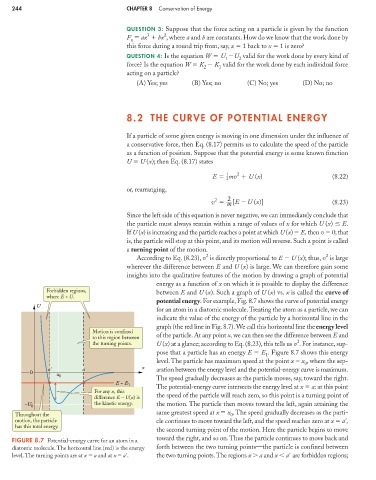
                                                            energy as a function of x on which it is possible to display the difference
                          Forbidden regions,                between E and U (x). Such a graph of U (x) vs. x is called the curve of
                          where E < U.
                                                            potential energy. For example, Fig. 8.7 shows the curve of potential energy
                       U
                                                            for an atom in a diatomic molecule.Treating the atom as a particle, we can
                                                            indicate the value of the energy of the particle by a horizontal line in the
                                                            graph (the red line in Fig. 8.7). We call this horizontal line the energy level
                                        Motion is confined
                                        to this region between  of the particle. At any point x, we can then see the difference between E and
                                                                                                      2
                                        the turning points.  U (x) at a glance; according to Eq. (8.23), this tells us v . For instance, sup-
                                                            pose that a particle has an energy E   E . Figure 8.7 shows this energy
                                                                                             1
                                                            level.The particle has maximum speed at the point x   x , where the sep-
                                                                                                         0
                           a'        a                 x    aration between the energy level and the potential-energy curve is maximum.
                     0
                              x 0
                                                            The speed gradually decreases as the particle moves, say, toward the right.
                                               E = E 1
                                                            The potential-energy curve intersects the energy level at x   a; at this point
                                         For any x, this
                                         difference E – U(x) is  the speed of the particle will reach zero, so this point is a turning point of
                    –U 0                 the kinetic energy.  the motion. The particle then moves toward the left, again attaining the
                                                            same greatest speed at x   x . The speed gradually decreases as the parti-
                 Throughout the                                                   0
                 motion, the particle                       cle continues to move toward the left, and the speed reaches zero at x   a ,
                 has this total energy.
                                                            the second turning point of the motion. Here the particle begins to move
                                                            toward the right, and so on.Thus the particle continues to move back and
                FIGURE 8.7 Potential-energy curve for an atom in a
                diatomic molecule. The horizontal line (red) is the energy  forth between the two turning points—the particle is confined between
                level. The turning points are at x   a and at x   a .  the two turning points.The regions x   a and x 	 a  are forbidden regions;

