


Page 85 - Fisika Terapan for Engineers and Scientists
P. 85
9.4  Elliptical Orbits; Kepler’s Laws                   285


                        Kepler’s Third Law relates the period of the orbit to the size of the orbit:

                        The square of the period is proportional to the cube of the semimajor axis of the
                                                                                              Kepler’s Third Law
                        planetary orbit.

                     This Third Law, or law of periods, is nothing but a generalization of Eq. (9.13) to
                     elliptical orbits.
                        Table 9.1 lists the orbital data for the planets of the Solar System. The mean
                     distance listed in this table is defined as the average of the perihelion and aphelion
                     distances; that is, it is the semimajor axis of the ellipse. The difference between the
                     perihelion and aphelion distances gives an indication of the elongation of the ellipse.


                      TABLE 9.1      THE PLANETS


                                                         MEAN DISTANCE
                                                           FROM SUN           PERIHELION        APHELION
                        PLANET (a)       MASS           (SEMIMAJOR AXIS)      DISTANCE          DISTANCE         PERIOD
                                                                                                      6
                                             23
                                                                                    6
                                                                 6
                        Mercury       3.30   10 kg       57.9   10 km       45.9   10 km      69.8   10 km       0.241 yr
                        Venus         4.87   10 24      108                107               109                 0.615
                        Earth         5.98   10 24      150                147               152                 1.00
                        Mars          6.42   10 23      228                207               249                 1.88
                        Jupiter       1.90   10 27      778                740               816                11.9
                        Saturn        5.67   10 26     1430               1350              1510                29.5
                        Uranus        8.70   10 25     2870               2730              3010                84.0
                        Neptune       1.03   10 26     4500               4460              4540               165
                        Pluto         1.50   10 22     5890               4410              7360               248


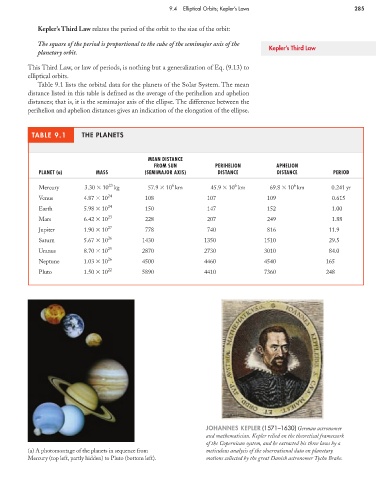
                                                                           JOHANNES KEPLER (1571–1630) German astronomer
                                                                           and mathematician. Kepler relied on the theoretical framework
                                                                           of the Copernican system, and he extracted his three laws by a
                     (a) A photomontage of the planets in sequence from    meticulous analysis of the observational data on planetary
                     Mercury (top left, partly hidden) to Pluto (bottom left).  motions collected by the great Danish astronomer Tycho Brahe.

