


Page 84 - Fisika Terapan for Engineers and Scientists
P. 84
284                                CHAPTER 9  Gravitation


                                                                        average velocities in the two time intervals. The velocities
                                                      For a central force,
                                                      the heights BP" and  differ because the gravitational force causes an acceleration.
                                                      AP are equal.
                                                                        However, since the direction of the force is toward the center,
                                                                        parallel to the radius, the component of the velocity per-
                                                      P"
                                                         B              pendicular to the radius cannot change.The component of
                                                                        the velocity perpendicular to the radius is represented by
                                                        P'              the line segment PA for the first time interval, and it is rep-
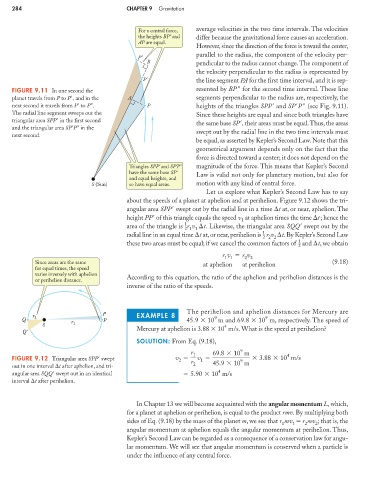
                FIGURE 9.11 In one second the                           resented by BP   for the second time interval. These line
                planet travels from P to P , and in the  A              segments perpendicular to the radius are, respectively, the
                next second it travels from P  to P .    P              heights of the triangles SPP  and SP P   (see Fig. 9.11).
                The radial line segment sweeps out the                  Since these heights are equal and since both triangles have
                triangular area SPP  in the first second
                                                                        the same base SP , their areas must be equal.Thus, the areas
                and the triangular area SP P  in the
                                                                        swept out by the radial line in the two time intervals must
                next second.
                                                                        be equal, as asserted by Kepler’s Second Law. Note that this
                                                                        geometrical argument depends only on the fact that the
                                                                        force is directed toward a center; it does not depend on the
                                                    Triangles SPP' and SP'P"  magnitude of the force. This means that Kepler’s Second
                                                    have the same base SP'  Law is valid not only for planetary motion, but also for
                                                    and equal heights, and
                                        S (Sun)     so have equal areas.  motion with any kind of central force.
                                                                           Let us explore what Kepler’s Second Law has to say
                                                   about the speeds of a planet at aphelion and at perihelion. Figure 9.12 shows the tri-
                                                   angular area SPP  swept out by the radial line in a time
t at, or near, aphelion. The
                                                   height PP  of this triangle equals the speed v at aphelion times the time
t; hence the
                                                                                      1
                                                                    1
                                                   area of the triangle is  r v ¢t . Likewise, the triangular area SQQ  swept out by the
                                                                    2 1 1
                                                                                            1
                                                   radial line in an equal time
t at, or near, perihelion is  r v
t. By Kepler’s Second Law
                                                                                            2  2 2
                                                                                                       1
                                                   these two areas must be equal; if we cancel the common factors of and
t, we obtain
                                                                                                       2
                                                                                r v   r v
                                                                                 1 1   2 2
                       Since areas are the same                           at aphelion  at perihelion             (9.18)
                       for equal times, the speed
                       varies inversely with aphelion
                       or perihelion distance.     According to this equation, the ratio of the aphelion and perihelion distances is the
                                                   inverse of the ratio of the speeds.
                                                                     The perihelion and aphelion distances for Mercury are
                      r 2                   P         EXAMPLE 8              9               9
                   Q              r         P                        45.9   10 m and 69.8   10 m, respectively. The speed of
                         S         1                                            4
                                                      Mercury at aphelion is 3.88   10 m/s. What is the speed at perihelion?
                   Q'
                                                      SOLUTION: From Eq. (9.18),
                                                                                     9
                                                                      r 1    69.8   10  m          4
                FIGURE 9.12 Triangular area SPP  swept              v    r  v        9     3.88   10  m/s
                                                                         1
                                                                   2
                out in one interval
t after aphelion, and tri-        2     45.9   10  m
                                                                               4
                angular area SQQ  swept out in an identical           5.90   10  m/s
                interval
t after perihelion.
                                                      In Chapter 13 we will become acquainted with the angular momentum L, which,
                                                   for a planet at aphelion or perihelion, is equal to the product rmv. By multiplying both
                                                   sides of Eq. (9.18) by the mass of the planet m, we see that r mv   r mv ; that is, the
                                                                                                     1
                                                                                                         2
                                                                                                  1
                                                                                                            2
                                                   angular momentum at aphelion equals the angular momentum at perihelion. Thus,
                                                   Kepler’s Second Law can be regarded as a consequence of a conservation law for angu-
                                                   lar momentum. We will see that angular momentum is conserved when a particle is
                                                   under the influence of any central force.

