


Page 306 - NS-2 Textbook
P. 306
ASTRONOMY                                                                                             301

       haze rises above each polar region during the 'winter sea-  40 degrees warmer due to absorption of the Sun's rays.
        sons. The polar regions grow and shrink during the win-  But because  of the  thin atmosphere,  the  air  a  few  feet
        ters,  which appear to  be similar  to  Earth  seasons.  The   above the ground may be as much as 80 degrees cooler
       Martian polar ice is  thought to  be composed of frozen   than  the smface itself.  The  daily  temperature  range  of
       carbon dioxide and frozen water vapor.                  about 170 degrees would be extremely uncomfortable, if
           Fierce  seasonal Martian  winds  whip  up huge dust   not fatal, to Earth's higher organisms. The polar regions
        storms of the pinkish-colored iron oxide that covers about   seem to have fairly constant temperatures of about -190
        three-fourths  of  the  Martian  surface.  The  windstorms   degrees F.
       may rage  for  months, at speeds of up to  300 miles per   Mars is  about twice  the diameter of the Moon and
       hour, covering much of the planet with swirling reddish   about half that of Earth. While Earth has a smface area of
        and yellowish dust clouds. The dust of Mars is extremely   197 million square miles, Mars is only about one-quarter
       fine, something like fine talcum powder. This dust some-  that size, 55", million square miles. Mars' gravity is only
        times is carried 35 miles above the planet's surface.   about one-third (0.38)  of Earth's.  TIlat means a  person
           Huge inactive volcanoes are present on the Martian   weighing 150 pounds on Earth would weigh only about
       surface. Nix Olympica (Snow of Olympus) is the size of   57 pounds on Mars.
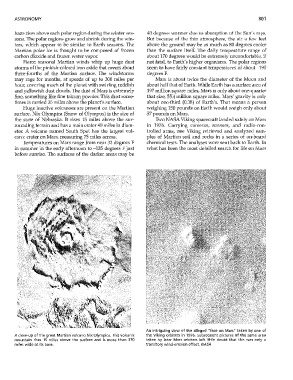
        the  state  of Nebraska.  It rises  15  miles  above  the sur-  Two NASA Viking spacecraft landed safely on Mars
       rounding terrain and has a main crater 40 miles in diam-  in  1976.  Carrying  cameras,  sensors,  and  radio-con-
       eter.  A  volcano named South Spot has the largest vol-  trolled arms,  one Viking retrieved and analyzed sam-
       canic crater on Mars, measuring 75 Iniles across.       ples of Martian soil  and rocks  in a  series  of on-board
           Temperatures on Mars range from near 32 degrees F   chemical tests. The analyses were sent back to Earth. In
       in summer in the early afternoon to -135 degrees F just   what has been the most detailed search for life on Mars
       before sunrise. The surfaces of the darker areas may be


                                                              An  intriguing view of the  alleged  "face  on  Mars"  taken  by  one  of
       A close-up of the great Martian volcano Nix Olympica. This volcanic   the Viking  orbiters  in  1976.  Subsequent pictures  of the same  area
        mountain  rises  15  miles  above  the  surface  and  is  more  than  370   taken  by  later  Mars  orbiters  left  little  doubt that this  was  only a
        miles wide at its  base.                              transitory wind-erosion effect. NASA

