


Page 305 - NS-2 Textbook
P. 305
300                                                                                     NAUTICAL SCIENCES

                                                                     The best time for viewing Mars is when it is nearest
                                                                  to Earth in August and  September.  In those  months it
                                                                  sometimes comes as close as 30 million miles. In Febru-
                                                                  ary and March it is over 60 million miles away and much
                                                                  less easily vieV\Ted. It is best seen ·when in direct opposi-
                                                                  tion-in other words, when Earth is directly between the
                                                                  Sun and Mars.
                                                                     Many scientists of the past thought Mars capable of
                                                                  supporting some kind of life. TIle Italian astronomer Gio-
                                                                  vanni Schiaparelli annotmced that he had observed a se-
                                                                  ries of intersecting lines on the Martian surface in 1877.
                                                                  He called them canali, Italian for "channels" or "canals,"
                                                                  Many people believed  that the  canali  must have been
                                                                  made by intelligent beings because they were so straight.
                                                                  Or  they  thought  that  perhaps  they  were  created  by
                                                                  free-flowing water, indicating that Mars could be capable
                                                                  of supporting life.  But subsequent observations and ex-
                                                                  tensive photography from the Mariner and Viking series
                                                                  of space probes definitively proved the canali to be an
                                                                  illusion.
                                                                     In 1969 and 1970 Mariller 6 and Mariller 7 made six-
                                                                  month-long  journeys  to  photograph  Mars,  looking
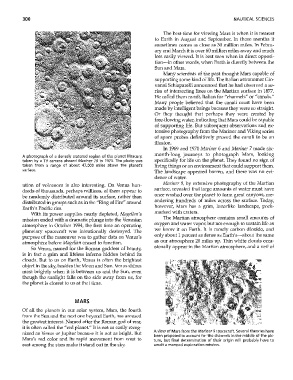
           A  photograph of a densely cratered  region  of the  planet Mercury,
           taken  by  a TV  camera  aboard Mariner  10  in  1974. The  photo was   specifically for life on the planet. They found no sign of
           taken  from  a  range  of  about  47,000  miles  above  the  planet's   living things or an environment that could support them.
           surface.
                                                                  TIle landscape appeared barren, and there was no evi-
                                                                  dence of water.
                                                                     Mari1ler  9, by extensive photography of the Martian
           ution  of  volcanoes  is  also  interesting.  On  Venus  hun-
                                                                  surface, revealed that large mnounts of water must have
           dreds of thousands, perhaps millions, of them appear to
                                                                  once washed over the planet to form great canyons, me-
           be randomly distributed around its surface, rather than
           distributed in groups such as in the "Ring of Fire" around   andering hWldreds  of miles  across  the  surface.  Today,
                                                                  however,  Mars  has  a  grim,  lWlarlike  landscape,  pock-
           Earth's Pacific rim.
              With its power supplies nearly depleted, Magel/ail's   marked with craters.
           mission ended with a dramatic plwlge into the Venusian    The Martian ahnosphere contains small amounts of
                                                                  oxygen and ,vater vapOl~ but not enough to sustain life as
           atmosphere in October 1994, the first time an operating
                                                                  we know it on Earth. It is mostly  carbon dioxide,  and
           planetary  spacecraft  was  intentionally  destroyed.  TIle
                                                                  only about 1 percent as dense as Earth's-about the same
           purpose of the maneuver was to gather data on Venus's
                                                                  as our atmosphere 20 miles up. Thin white clouds occa-
           atmosphere before Magel/all ceased to nmction.
                                                                  sionally appear in the Martian atmosphere, and a veil of
              So Venus, named for the Roman goddess of beauty,
           is  in fact  a  grim and lifeless inferno hidden behind its
           clouds. But to us on Earth, Venus is often the brightest
           object in the sky, besides the Moon and Sun. Venus shines
           most brightly when it is between us and the Sun, even
           though the sunlight falls on the side away from us, for
           the planet is closest to us at that time.


                                 MARS
           Of all  the  planets in our solar system, Mars, the fourth
           from the Stm and the next one beyond Earth, has aroused
           the greatest interest. Named after the Roman god of war,
           it is often called the "red planet." It is not as easily recog-
                                                                 A view of Mars from the Mariner 9 spacecraft. Several theories have
           nized as Venus or Jupiter because it is not as bright. But
                                                                 been proposed to account for the channels in the middle of the pic-
           Mars's  red  color  and  its  rapid lllovement  from  V\Test  to   ture,  but final  determination of their origin  will  probably have to
           east among the stars make it stand out in the sky.    await a manned exploration mission.

