


Page 65 - JURNAL PENYELIDIKAN AKADEMIK
P. 65
J u r n a l   P e n y e l i d i k a n   A k a d e m i k   I P G M   J i l i d   5 / 2 0 2 0  | 58


               INTRODUCTION

               Ministry of Education Malaysia (MOE) has incorporated computational thinking (CT)
               and computational science through the Kurikulum Standard Sekolah Rendah (KSSR)
               and Kurikulum Standard Sekolah Menengah (KSSM) starting 2018. This is supported
               by  Malaysia  Digital  Economy  Corporation  (MDEC)  which  will  benefit  1.2  million
               students for 10,173 schools from all over Malaysia. CT will be integrated through the
               Reka  Bentuk  Teknologi  (RBT)  subjek  in  primary  schools  and  Science  Computer
               subject in secondary schools.  MDEC in collaboration with Institut Pendidikan Guru
               Malaysia (IPGM) had conducted Training of Trainer (TOT) course for primary school
               RBT in-service teachers on computational thinking in the year 2019. The course was
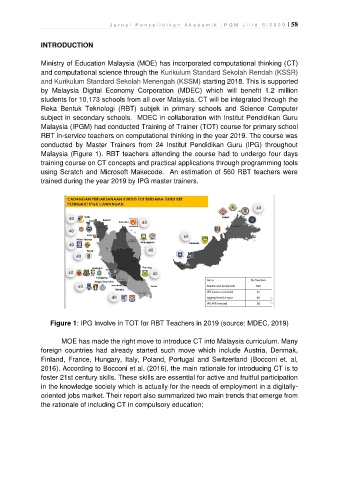
               conducted  by  Master  Trainers  from  24  Institut  Pendidikan  Guru  (IPG)  throughout
               Malaysia (Figure 1). RBT teachers attending the course had to undergo four days
               training course on CT concepts and practical applications through programming tools
               using Scratch and Microsoft Makecode.  An estimation of 560 RBT teachers were
               trained during the year 2019 by IPG master trainers.


                   Figure 1: IPG Involve in TOT for RBT Teachers in 2019 (source: MDEC, 2019)

                       MOE has made the right move to introduce CT into Malaysia curriculum. Many
               foreign  countries  had  already  started  such  move  which  include  Austria,  Denmak,
               Finland,  France,  Hungary,  Italy,  Poland,  Portugal  and  Switzerland  (Bocconi  et.  al,
               2016). According to Bocconi et al. (2016), the main rationale for introducing CT is to
               foster 21st century skills. These skills are essential for active and fruitful participation
               in the knowledge society which is actually for the needs of employment in a digitally-
               oriented jobs market. Their report also summarized two main trends that emerge from
               the rationale of including CT in compulsory education;

